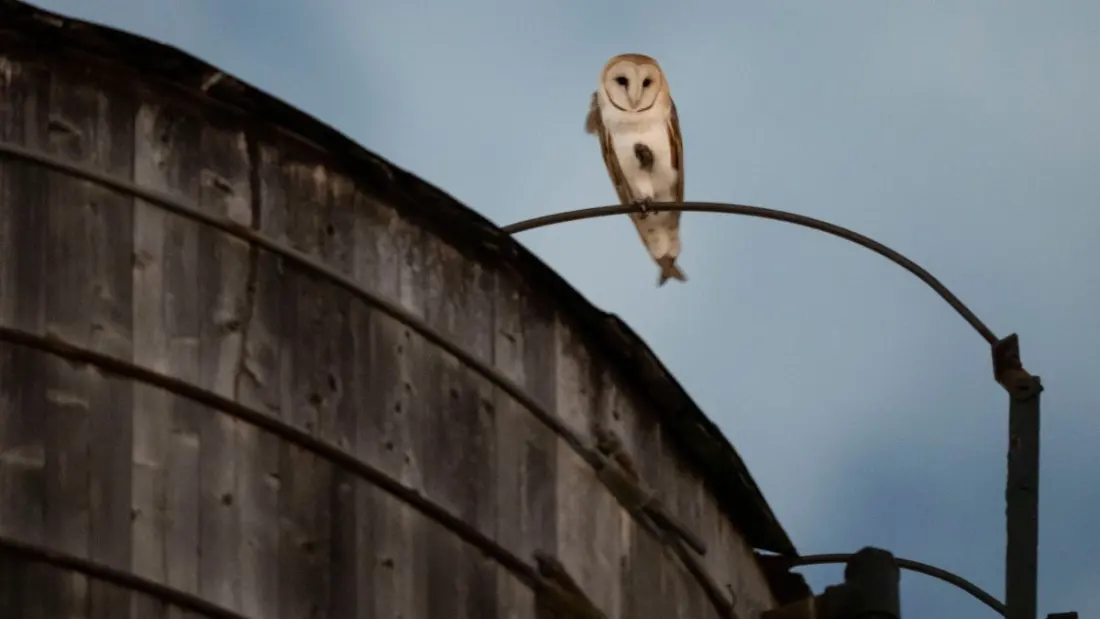
New York has a new set of celebrities, and they're nocturnal. A family of barn owls has taken up residence in a water tower on West 75th Street, steps from Central Park West, and locals are gathering on the pavement every evening at dusk hoping to catch a glimpse.
This is big news for birders. According to Andrew Farnsworth, a migration ecologist at the Cornell Lab of Ornithology, it's the first documented barn owl nest in Manhattan in recorded history. The story broke on October 6, when resident Elisabeth Williams reported that she and her husband had spotted multiple owls around the water tower — after first seeing a lone bird on their apartment windowsill days earlier.
David Barrett, who runs the Manhattan Bird Alert account, has counted at least one adult and five fledglings, with some photographers claiming six young. Two adults are believed to be present, and he's watched them ferry rodents back to the nest. For context: New York sits at the northern edge of the barn owl's range, and the state's population has declined sharply, so even a single sighting is rare here — let alone a breeding family.
Long before the owls were identified, neighbours knew something strange was happening. Residents on the block had been hearing eerie screeching and wailing since early September, sometimes mistaking it for a child in distress. One man said it sounded, unsettlingly, like someone being murdered outside. That blood-curdling call is simply how barn owls talk to each other, Farnsworth explained — a "horror movie" sort of noise. One neighbour, Thomas Obersteiner, has turned his roof deck into an unofficial viewing platform, welcoming photographers almost nightly; twenty showed up one evening.
The owls join a proud New York tradition of beloved birds. American woodcocks pass through Midtown's Bryant Park each spring, red-tailed hawk Pale Male nested above Fifth Avenue for three decades until his death in 2023, and when Flaco the Eurasian eagle-owl died in 2024, dozens of admirers gathered to mourn him after his year of freedom around Manhattan.
One local caution worth knowing: onlookers are hoping the owls avoid eating rats poisoned by rodenticide, a real hazard for urban raptors. And for a city where encountering wildlife usually takes effort, Williams put it well — here it was, right outside the window. She and her husband weren't birders before. They suspect that's about to change.