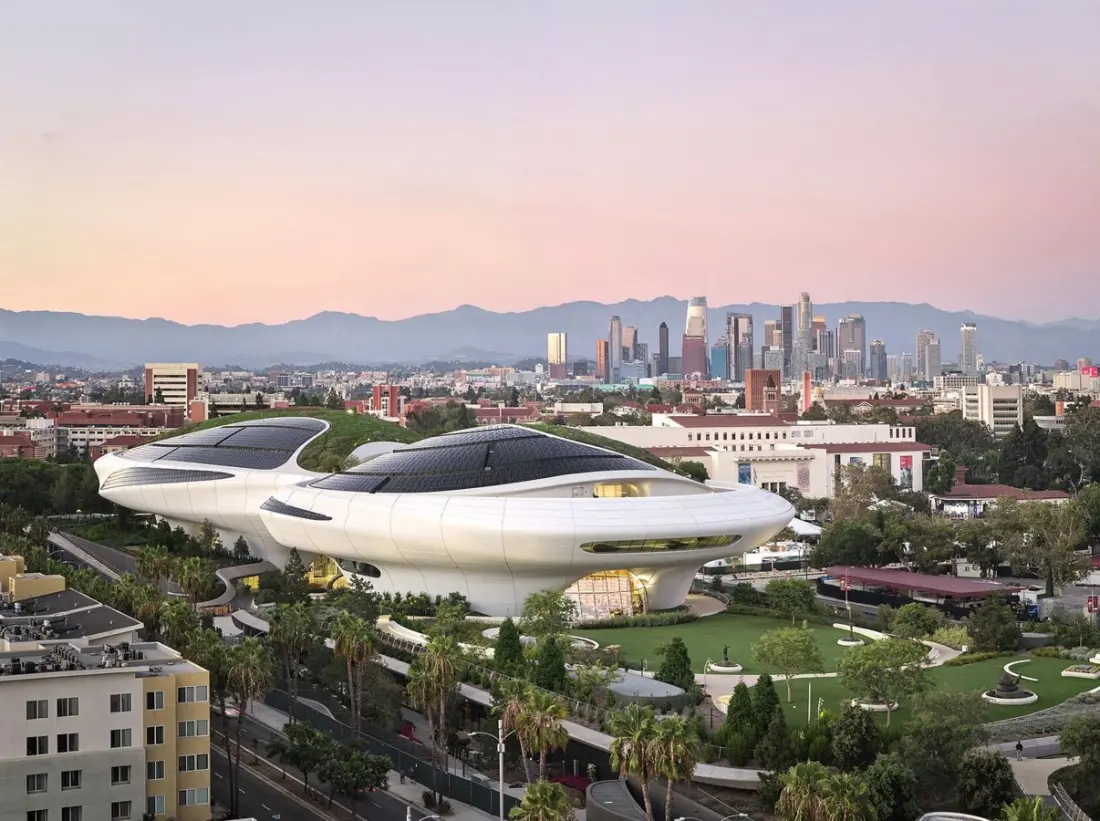
After nearly two decades, three cities and a string of rejections, the Lucas Museum of Narrative Art opened its doors in Los Angeles on September 22. Built on what was once a parking lot in Exposition Park, the 300,000-square-foot, five-storey building sits on a 13-acre campus designed to evoke California's hills, canyons and meadows, with a curving structure by architect Ma Yansong that has frequently been mistaken for a starship. It is not one, he insists — it nods to clouds and tree canopies instead.
Inside, the museum throws out the usual art-world rulebook. Founder George Lucas, whose founding gift of 40,000 items fills galleries with roughly 1,200 works on view, wanted to break down hierarchies between fine art and popular culture. So a Frida Kahlo self-portrait shares space with a dogs-playing-poker canvas and the Batman suit from The Dark Knight. A Banksy hangs near an exhibition of children's book illustration featuring Beatrix Potter and Maurice Sendak. Japanese manga sits alongside Dorothea Lange and Frank Frazetta. Lucas never sold a piece he bought: his rule was simply that the work moved him.
Visitors are given no map. There's no pamphlet pointing you to David Hockney or Norman Rockwell's The Problem We All Live With, on loan from the Norman Rockwell Museum. More than 30 galleries are loosely grouped around themes like love, community, history and play, with the rest left to wander. It's a deliberate gamble on curiosity over curation — one that mirrors LACMA's new David Geffen Galleries, which similarly lets visitors chart their own route.
A few corners do offer more guidance. The Rockwell gallery pairs the graphite draft and final oil of The Runaway (1958) with a 2014-15 reinterpretation by Richard Williams, showing how popular images get reworked over time. Original Peanuts comics carry editorial notes in the margins, and Sendak's Where the Wild Things Are pages reward close-up looks at his brushwork. Star Wars vehicles, naturally, appear against painted alien backdrops, while two theatres screen documentaries and experimental short films. There's also a public research library, a mural gallery, and a restaurant on the top floor.
For travellers, the museum is a genuinely new anchor for a South LA itinerary that already includes the California Science Center and the Memorial Coliseum next door. The building itself is free to enter, and locals in the 90037 ZIP code get free passes for themselves and a guest. The genealogy of the project — rejected by San Francisco's Presidio Trust in 2014, stalled in Chicago in 2016, finally signed with LA in 2017 — makes its arrival something of a civic event. Whether you go for the comics, the Kahlo or just to decide for yourself what that building resembles, it's one of the most distinctive museum openings in the US in years.