
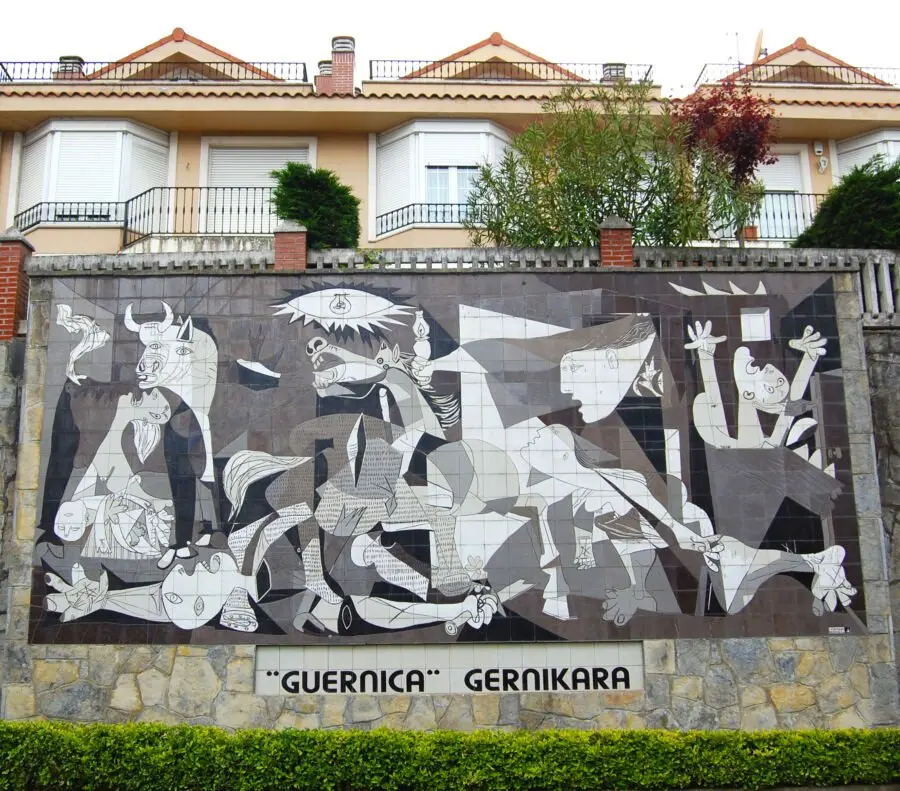
On 26 April 1937, the market town of Guernica in Spain's Basque Country became the target of the world's first saturation aerial bombing of civilians. General Franco, locked in the Spanish Civil War against Spain's elected government, allowed Hitler to test Germany's new air force on the defiant Basques. The raid flattened the town in a way that was shocking for its time — though, as the years that followed showed, horrifyingly precedented.
News reached Pablo Picasso, then living in Paris. He responded with a canvas more than 25 feet wide: howling women, a screaming horse with a spear in its back, a fallen fighter with a broken sword, a bull standing over a mother and her dead baby, all lit by the harsh glare of a bare bulb. The black-and-white palette echoed the newspaper photographs that had carried the story around the world, and the Cubist style made the scene feel like bomb-shattered fragments reassembled on canvas. Debuted at the 1937 Paris exposition, it caused an immediate sensation and showed the world the brutality of the rising fascist movement before World War II made it unmistakable.
For travellers, the story has a satisfying ending — in two places. A full-scale recreation of the painting now covers a wall in Guernica itself, in the Basque town where it all happened, and the original hangs in Madrid as Spain's national artwork. Picasso refused to return to Spain while Franco ruled; after the dictator's death in 1975, the painting ended its decades of exile in New York and came home.
Why does this matter to a visitor? Because few artworks anywhere are so tied to a real place and a real event. In Guernica, you can stand in the actual town, see the Basque culture Franco tried to crush, and reflect on a raid that killed civilians the world once dismissed as 'collateral damage'. In Madrid, you can confront the original in person — a painting that honors the victims of the Spanish Civil War (half a million dead), World War II, and every conflict since. It's one of the few museum stops that doubles as a history lesson and, frankly, a punch to the gut.
Pair the two and you get a deeper read on Spain than any guidebook summary: Basque resilience, the civil war's scars, and a dictator's long shadow — all told through a single, unforgettable image.