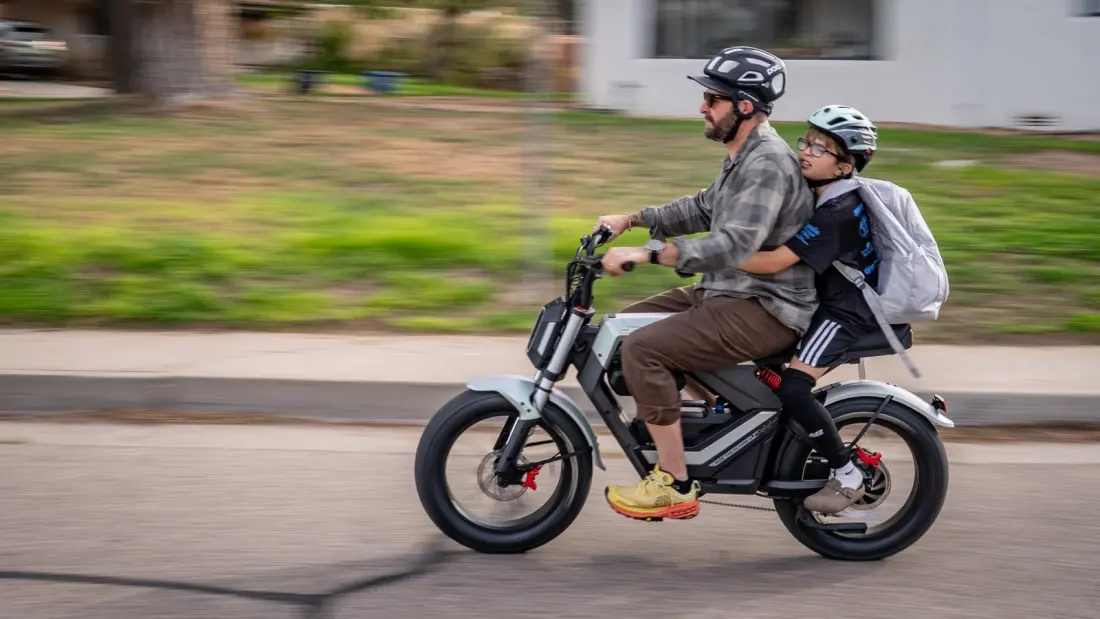
Weekday afternoons are the worst part of many parents' day: school pickup, a snack, then hours in traffic shuttling kids to soccer and cross-country practice. One writer in Albuquerque, New Mexico, decided to test whether an e-bike could replace the family minivan for those trips—and the answer was a resounding yes.
His test rig was the Aotos Flux X26 Pro, a long-seat e-bike with room for two riders and a 50- to 70-mile range, enough for a week of errands. There was a wrinkle: with 750 watts of standard power and a red-button boost that pushes it to 2,000 watts and 28 mph for ten seconds, it technically crosses into 'motor-driven cycle' territory under federal and New Mexico rules. He stuck to e-bike limits—under 20 mph, no boost—to stay legal on the city's bike paths.
The first ride to his 10-year-old's soccer practice took only about five minutes longer than driving. His son, initially nervous after an earlier e-motorcycle crash, was hooked by the end and declared he never wanted to drive again. Instead of sitting in a car arguing about lateness, the two chatted the whole way. The routine now works for both kids: he drops his 13-year-old at cross-country first, then heads to soccer, leaving a few minutes earlier than he used to. Bonus: his daughter is learning the route and gaining confidence riding near traffic on her own.
The bike itself held up well. Four-inch tires and hydraulic suspension smooth out rough paths, the brake and headlight setup is solid after dark, and three power modes—eco (10 mph), normal (15 mph) and sport (20 mph)—let him balance battery life against speed in traffic. He admits he mostly uses the throttle with pedals as footrests, which critics say makes bikes like this a 'moped in disguise.' A more experienced colleague suggested testing lighter, genuinely pedal-first commuter e-bikes instead, which may be more reliable and agile for family hauling.
The swap has practical payoffs beyond fun. The family's pickup and minivan manage about 18 mpg, and idling in after-work traffic burns an extra quarter-tank a week—meaningful when gas costs nearly $5 a gallon. Cold-weather riding is doable too: with evening temperatures in the 40s and 50s, weatherproof jackets, gloves and hats keep everyone comfortable, though he admits the experiment will pause once freezing weather and the end of the kids' sports seasons arrive in mid-November.
Why does this matter for travellers? If you've ever considered renting or buying an e-bike to replace short car trips—school runs, errands, or getting around on holiday—this is a real-world proof of concept. A long-seat e-bike can handle kid transport on short urban routes with only a small time penalty, and it turns a chore into the best part of the day. Just check local e-bike laws before you ride: power output and speed caps determine where you're actually allowed to ride. Source: Outside Online.