Long before smartphones, Hawaiians were playing a strategy game so absorbing it reportedly drew crowds that stood around watching for hours. Kōnane, once played across the islands by chiefs and commoners alike, has spent much of the last two centuries in decline — but it's now enjoying a revival, complete with its first modern tournament and a free online platform.
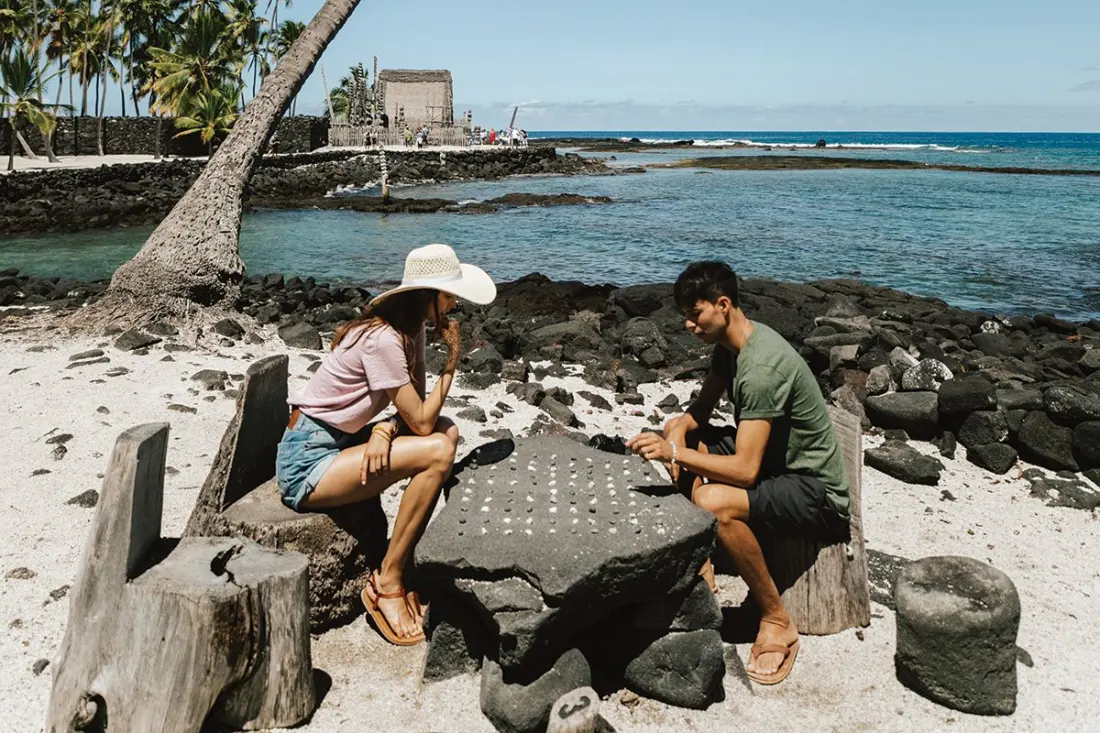
The traditional version was played on a papamū, a board carved or chipped into stone with shallow holes forming a grid, filled with black and white pebbles known as 'ili'ili. Boards came in different sizes and configurations, so every game posed a fresh puzzle. The rules are deceptively simple: pieces move forwards, backwards, left or right — never diagonally — and you capture an opponent's piece by jumping over it into an empty space, removing it from the board while restricting their future moves. The winner is whoever makes the final move. It rewards patient, consequence-based thinking rather than speed.
Like many Hawaiian cultural practices, kōnane faded sharply after Western contact. The turnaround is recent and tangible. In February, Bishop Museum on O'ahu hosted the Ka Makou Kōnane Invitational Tournament — the first competition of its kind in modern Hawai'i — with eight players vying for the title. Then in July, Andrew "Keahi" Castro, a mathematics and statistics student in Windward Community College's Hawai'iloa program, launched Likōnane (likonane.org), a free digital platform he built over several years as a passion project.
The site packs in tutorials, live multiplayer matches, puzzles and an AI opponent, so complete beginners can learn without finding a local player first. Castro deliberately wove 'ōlelo Hawai'i (the Hawaiian language) throughout the interface, meaning even casual players absorb a little language and culture along the way. That's the wider point: he built Likōnane to connect people not just with each other but with Hawaiian culture itself.
Uptake has been quick. Within four weeks of launch, 400 people had logged on to play — mostly from Hawai'i, but also from California, Washington and Texas, with some players as far afield as Europe and South America. As Castro puts it, there's something remarkable about being able to play an ancient island game with opponents around the world.
Why does this matter for travellers? If you're heading to Hawai'i, kōnane offers something more meaningful than another beach day. You can try the game online before your trip, then look for papamū stone boards at historic sites and cultural centres — some survive at places like Puʻuhonua o Hōnaunau on the Big Island. It's also a nice souvenir alternative: learning a game that Hawaiian families played for centuries beats a fridge magnet. And if your timing is lucky, keep an eye out for community kōnane events or future tournaments, which seem likely to grow now the first invitational is done.