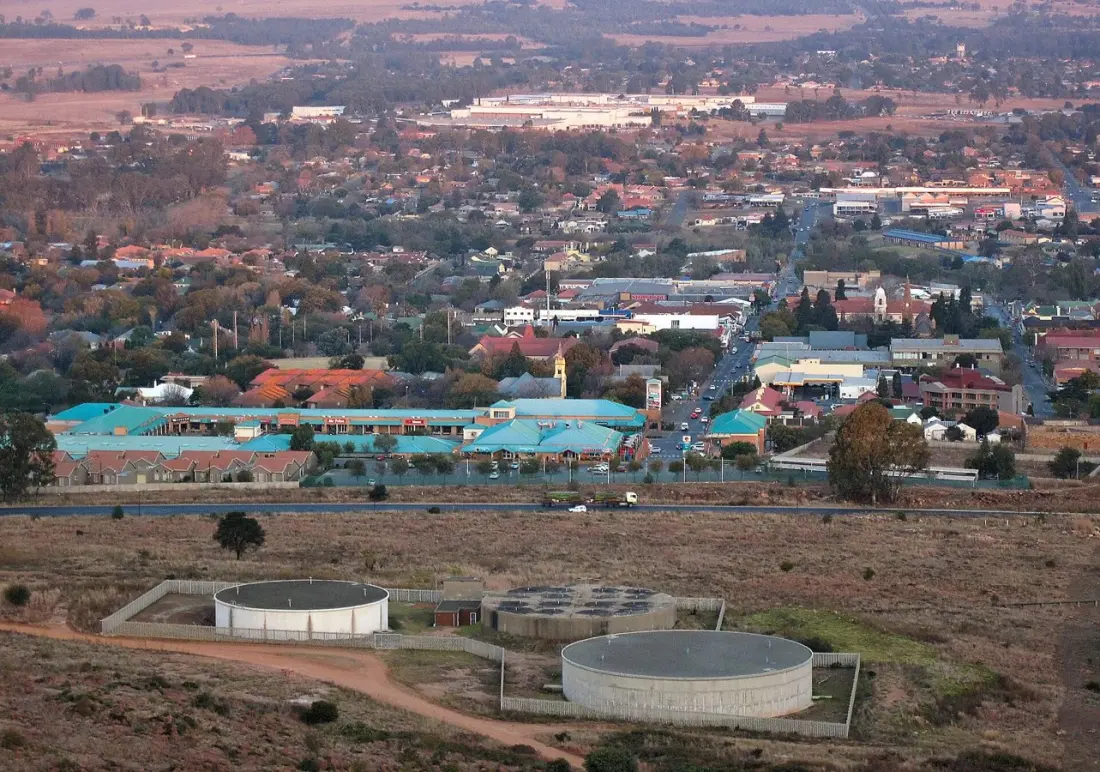
An hour's drive from Johannesburg's sprawl sits Heidelberg, a Gauteng town most people speed past on the N3. That's a shame, because this was briefly the capital of a republic. During the First Anglo-Boer War, with no British garrison in town, the Zuid-Afrikaansche Republiek made Heidelberg its seat of government — and it was here, on 16 December 1880, that the republican flag was hoisted, marking the war's opening act.
The town itself was proclaimed in 1866 after German-born trader Heinrich Ueckermann set up shop on the farm Langlaagte, and a settlement grew around his store. Its best-known landmark is the Klipkerk, a Norman-style church on the town square designed by architects Brislin and Seal. Commandant General PJ Joubert laid its cornerstone in April 1890, and it was inaugurated the following March. The tower collapsed in 1909 after heavy rain and structural faults, but was rebuilt to match the original.
Not all of Heidelberg's history is easy viewing. During the South African War (1899–1902), British forces ran concentration camps in the district, including four for Black South Africans at Heidelberg, Nigel, Balfour and Greylingstad. Around 2,300 people were held at the Heidelberg camp under grim conditions — poor food, limited medical care, forced labour for the military. Records list 150 deaths there, 121 of them children. The camp cemetery, rediscovered in 1999 via an old map with roughly 30 graves identified behind Heidelberg Mall, finally received a heritage blue plaque from the Heidelberg Heritage Association in August 2026.
The town also wears its railway history on its sleeve — or at least it used to. Heidelberg station opened in October 1896, became a national monument in 1975, and later housed the Heidelberg Heritage Museum with its photos, artefacts and railway memorabilia. Its segregated waiting rooms once told their own story about apartheid-era South Africa. The bad news: the building has deteriorated and was reported closed in September 2026 amid management disputes, so check ahead before planning a stop.
There's a literary footnote too. Dr A.G. Visser, one of Afrikaans poetry's most celebrated voices, moved to Heidelberg in 1916 to practise medicine while he wrote. His 1890 house and consulting rooms still stand at the corner of Van der Westhuizen and HF Verwoerd streets, marked by a heritage plaque.
Why bother? If you've done the Cradle of Humankind and the Apartheid Museum, Heidelberg is a rewarding heritage detour that most Gauteng itineraries skip. You can walk the church square, find the concentration camp memorial, and trace a strand of history that runs from a republican flag-raising to the war that reshaped southern Africa. It's not a polished tourist experience — part of its appeal is that you'll likely have the streets to yourself. Go with some reading done beforehand and confirm which heritage buildings are open; the town rewards a bit of preparation.