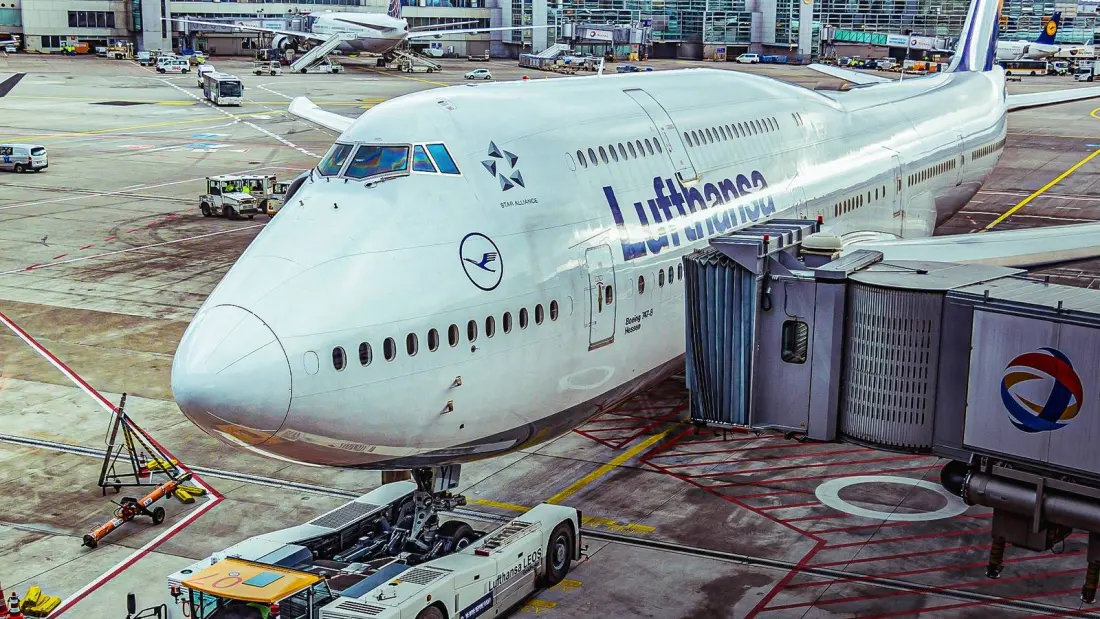
Ever wondered where pilots vanish to on a 14-hour flight? On the Boeing 747-8 — the longest passenger aircraft ever built until the 777X arrived — the answer is a pair of hidden compartments most passengers never notice.
The 747-8 entered service in the early 2010s: Cargolux took the freighter version in late 2011, and Lufthansa launched the passenger Intercontinental on 1 June 2012 between Frankfurt and Washington. It's a serious machine — 76.3 metres long, a 68.4-metre wingspan with 787-derived raked wingtips, GEnx-2B engines, a max take-off weight of roughly 442 tonnes and a range of 8,140 miles. Lufthansa remains its best-known passenger operator.
On flights that regularly run 10 to 12 hours or more, safety rules require extra pilots and cabin crew — and those crew need somewhere to actually lie down. On the 747-8, the pilots get a compact compartment just behind the flight deck on the upper deck, with two bunks stacked one above the other, privacy curtains, dimmable lighting, airflow controls and sound dampening. It's reached through a discreet door passengers can't see into.
The cabin crew's space is bigger: a series of bunks above the aft section of the main deck, accessed by a narrow staircase from the rear galley service area. Flight attendants rotate through rest periods there while others work the cabin.
This isn't unique to the 747. The 787, 777, A350 and A380 all carry similar hidden rest areas — some above the cabin, some below, some near the cockpit. Short-haul jets like the 737 and A320 have nothing equivalent; crews just sit in their jump seats and rest on the ground between flights, occasionally using a blocked passenger seat on longer sectors.
What's changing is the ambition. Newer designs focus on sleep quality, not just box-ticking: circadian-friendly lighting, better insulation, climate control and even smart systems that could track sleep and feed into crew scheduling to predict fatigue before it becomes a safety issue. Regulators are expected to start grading rest quality, not merely rest duration — which should finally close the historical gap where cabin crew got noticeably worse facilities than pilots.
Why should a traveller care? Because crew fatigue management directly affects the safety of the ultra-long flights airlines increasingly sell — think Singapore to New York or Perth to London. And if you're flying a 747-8, knowing there's a hidden loft of sleeping crew above the rear galley adds a little wonder to the walk to the lavatory. Aviation nerds can still book the type with Lufthansa, where it serves flagship long-haul routes out of Frankfurt.