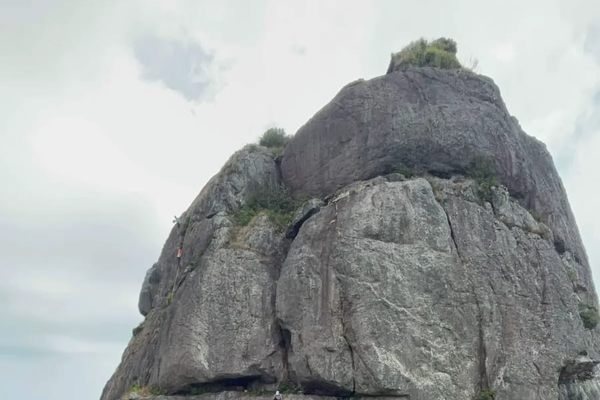
Somewhere in the hills above De Gi, in Phu Cat district on Vietnam's south-central coast, a small brick tower stands alone on top of a rocky outcrop nearly 800 metres above sea level. Hon Chuong is one of the last Cham towers in the country that most travellers — and plenty of locals — have never heard of.
The Champa civilisation, which flourished in central and southern Vietnam for over a thousand years before fading around the 15th century, left behind hundreds of Hindu temples and towers. The famous ones at My Son or Po Nagar draw busloads of visitors. Hon Chuong is the opposite experience: a compact, solitary ruin with no ticket booth, no crowds and no firm answers about when it was built or what it was actually for. Its exact dating remains unresolved, which is part of the appeal for anyone who likes their history with a question mark attached.
The setting does a lot of the heavy lifting. From the summit at 779 metres you get sweeping views over mountain ridges and the wild terrain that rolls down toward the coast near De Gi. Because so few people make the climb, the site feels genuinely untouched — closer to an expedition than a sightseeing stop.
That's the honest caveat: this is not a casual detour. The route up is remote and rugged, and the source recommends solid trekking and mountaineering skills before attempting it. A local guide is strongly advised, both for navigation and for safety on trails that see very little foot traffic. Timing matters too — go in the dry season, when the weather is stable and the paths are at their safest, rather than gambling on the central coast's wet months.
For a certain kind of traveller, though, this is exactly the draw. If you've already seen Vietnam's headline Cham sites and you'd rather have a summit to yourself than a queue, Hon Chuong delivers something increasingly rare: an ancient monument where the biggest challenge is simply getting there. Pair it with time on the beaches around De Gi or Quy Nhon, and you've got a trip that mixes coast, hills and a genuinely obscure piece of history.
Reported by Atlas Obscura.