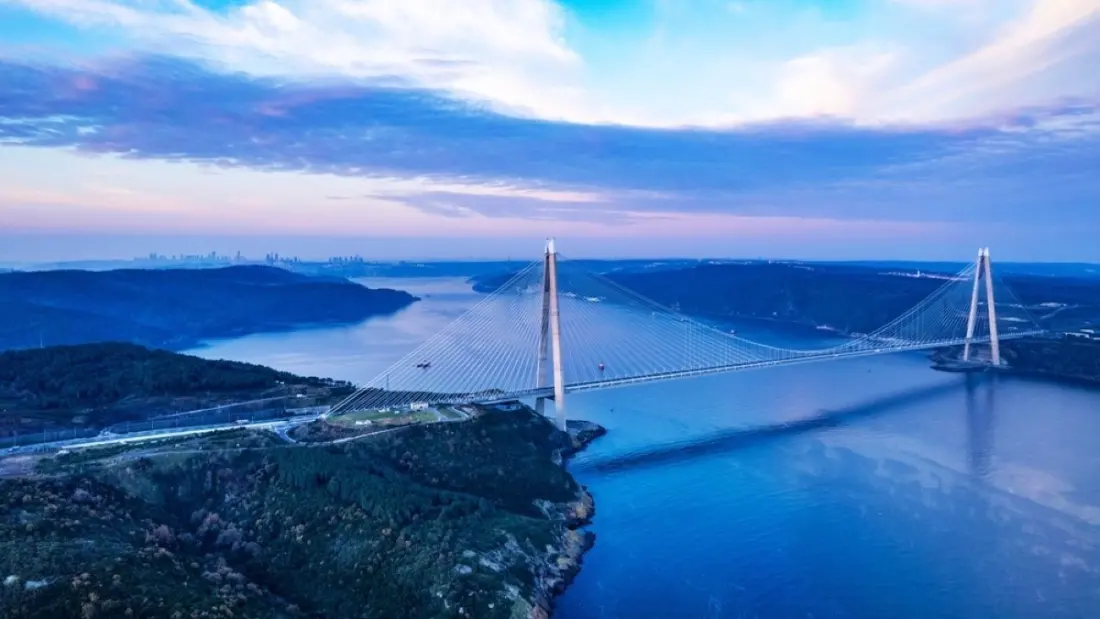
The most consequential travel-adjacent story out of Türkiye this year barely trended. In April, Treasury and Finance Minister Mehmet Şimşek signed a financing deal with the World Bank for a freight railway across the Yavuz Sultan Selim Bridge — the third-largest project the bank has ever approved, and the anchor of a $6.75 billion package from six multilateral lenders. It is the largest foreign-financed railway project in Turkish history, and it plugs the last big gap in a chain of rail links stretching from China to Europe.
Here's the context. For years, freight trains crossing between Asia and Europe had to squeeze through Marmaray, the undersea Bosporus tunnel shared with Istanbul's commuter trains, on restricted schedules. That was never going to scale. The new Northern Railway Crossing fixes it: trains will start at Çayırova near Gebze, pass Sabiha Gökçen Airport, cross the bridge — which was built with a double-track railway baked in — run past Istanbul Airport and join the high-speed line toward Europe at Çatalca. Bypassing the city entirely, it should allow round-the-clock freight, with projected capacity of 30 million tons of cargo and 33 million passengers a year.
The bridge crossing is one piece of a wider map. The Baku-Tbilisi-Kars railway, the backbone of the Türkiye-Georgia-Azerbaijan partnership, is now running at full capacity, and Armenian cargo started moving on the Akhalkalaki-Kars line in May. A 224-kilometre line to Azerbaijan's Nakhchivan, backed by $2.8 billion in green financing, is under construction with targets of 15 million tons of freight and 5.5 million passengers annually. Add the Zangezur Corridor framework agreed in Washington in August 2025, and a continuous rail route emerges: Central Asia across the Caspian, through Azerbaijan and Nakhchivan, into Türkiye and on to European markets.
Demand is no longer theoretical. When conflict between the United States and Iran effectively closed the Strait of Hormuz, shippers scrambled for alternatives and traffic on this Middle Corridor surged — the Asian Development Bank has since committed more than $9 billion to develop it. The new Istanbul bypass will also serve the Development Road running from the Gulf through Iraq. In short, a container loaded in Kazakhstan or the Gulf will soon be able to reach Europe through Türkiye without queuing for a slot under the Bosporus.
Why should a traveller care? Most of this is freight, but it reshapes the map you move through. Better rail infrastructure tends to pull passenger services along with it, and corridors like Baku-Tbilisi-Kars already make overland journeys across the Caucasus and eastern Anatolia genuinely viable. Istanbul, meanwhile, stays what it has always been: the hinge city between two continents, now with even more of the world's trade passing through it. If you've been weighing a Caucasus or Central Asia trip, know that the region is connecting — and getting easier to reach — faster than ever.
Daily Sabah Travel