
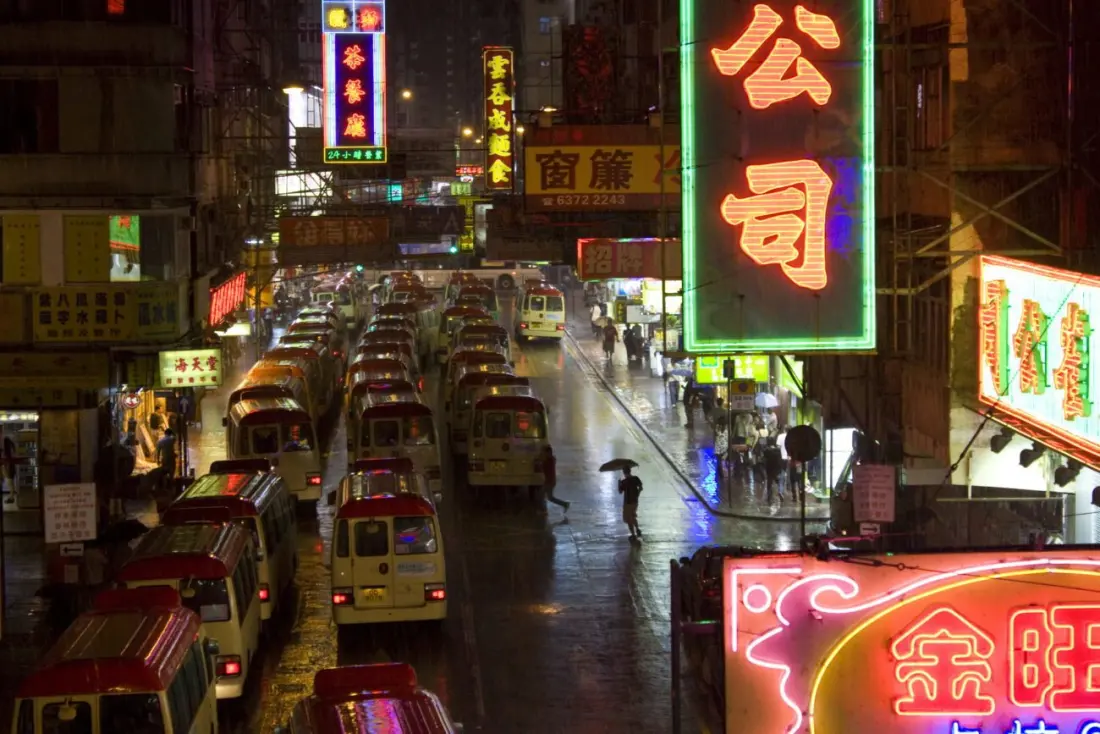
At its peak, Hong Kong may have had more neon signs than any city in history. Today, conservation groups count fewer than 400. The rest vanished almost overnight after a 2010 regulatory crackdown — and what's happening next could reshape how travellers experience the city after dark.
The turning point came on 31 December 2010, when Hong Kong's Buildings Department introduced the Signboard Control System. New rules on sign size and placement made roughly 190,000 signboards illegal, and non-compliant ones were removed. Neon wasn't the only target, but it was the most visible loss. Crucially, the signs weren't replaced with LED equivalents — they simply disappeared.
That matters because Hong Kong's neon was never just advertising. Emerging after World War II, the signs fused Chinese calligraphy and auspicious motifs with Art Deco geometry and multilingual text in Chinese, English and Japanese. Each one was handmade through a chain of specialists: calligraphers, metalworkers, electricians and tube benders trained under a master-apprentice system. Photographer Greg Girard, who arrived in 1972, recalls neon "dripping from every street and building" — signage that projected over pavements and turned corridors like Nathan Road into glowing urban rooms.
Now a small conservation movement is trying to keep the craft alive. Architects Kevin Mak and Ken Fung, co-founders of @streetsignhk, document and exhibit surviving signs, and their installation Ne-on-Ne-on — made with artist Choi Sai-ho and neon master Wu Chi-kai — experiments with lightweight, mobile structures that reimagine neon outside the old sign box. Elsewhere, artist Jive Lau trained in Taiwan to bypass the shrinking apprenticeship route, and through his studio Kowloneon runs workshops, creates art installations and builds contemporary signage for businesses that want a piece of the heritage.
There are hints of a revival. Lau reports a surge of interest in the past year, and the Luminous Neon exhibition at Hong Kong's new Design Museum — pairing historic signs with his new work — proved popular enough to run for nearly two months extra. Workshops are booked out, and business owners now approach Mak and Fung rather than the reverse. Still, the odds are steep: the old master craftsmen are largely retired or gone, and LED remains cheaper and brighter. No restaurant in 2026 needs neon the way one did in 1985.
For travellers, the practical upshot is this: the all-enveloping neon canopy immortalised in films like John Woo's Hard Boiled (1992) won't return, but scattered streets in Kowloon still glow the old way, with hand-bent glass and colours that bleed into one another. If you're visiting, look up on older commercial strips, and check what's on at the Design Museum — neon heritage has become an exhibition draw in its own right. For anyone who loves cities as living museums, this is a rare chance to see both the remnants of a golden age and the fight to keep its craft from dying out.
First reported by Roads & Kingdoms.