
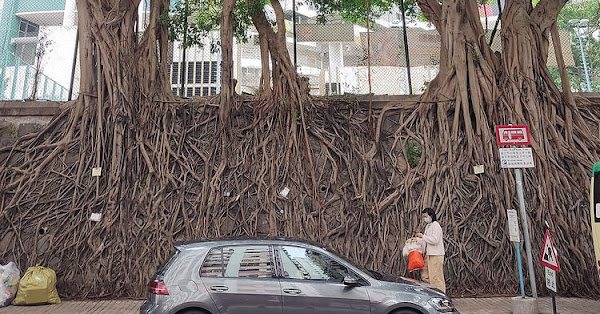
In Hong Kong, some of the most impressive trees don't grow in forests at all. They sprout sideways from old stone retaining walls, trunks and roots spilling over granite blocks in a feat that looks impossible. Locals call them stone wall trees, and they've become one of the city's quiet signatures.
The story starts in the colonial era, when engineers lined Hong Kong's steep hillsides with thousands of masonry retaining walls. Cracks between the granite blocks collected dust, fallen leaves and rainwater, forming miniature pockets of soil. Seeds arriving via birds and wind took root in these gaps, and over generations the walls turned into vertical gardens.
The star of the show is the Chinese banyan (Ficus microcarpa), a species whose roots are unusually good at threading through narrow stone joints in search of water. Given decades, a wall banyan can top twenty metres, its root network gripping the wall like a living scaffold. The result is the striking illusion of a full-sized tree erupting from bare rock.
These trees earn their keep, too. Because they occupy vertical space rather than ground level, they add greenery to dense streets without taking up room, and they shade pavements through Hong Kong's punishing summers. City authorities treat many of them as heritage worth protecting, balancing their ecological and cultural value against the genuine concern that heavy trees can destabilise ageing walls — occasionally a wall tree has to be removed for safety.
For visitors, spotting them is one of the more rewarding free activities in the city. Old neighbourhoods built on slopes — think Sheung Wan, Sai Ying Pun, Kennedy Town and parts of Wan Chai — are prime hunting grounds, with famous specimens along streets like Forbes Street and Forbes Path. A slow wander up any steep, wall-lined lane usually turns up a banyan or two. Photographers love the contrast of gnarled roots against neat brickwork, and it pairs nicely with the area's antique shops, temples and staircase streets.
It's also a lesson in how cities and nature negotiate. Hong Kong is relentlessly vertical, and these trees solved the space problem by claiming the walls themselves. Few places let you stand on a busy pavement and look up at a mature tree growing out of masonry — which is exactly why it's worth building an hour of wall-tree spotting into any first-time Hong Kong itinerary.
Story via Amusing Planet.