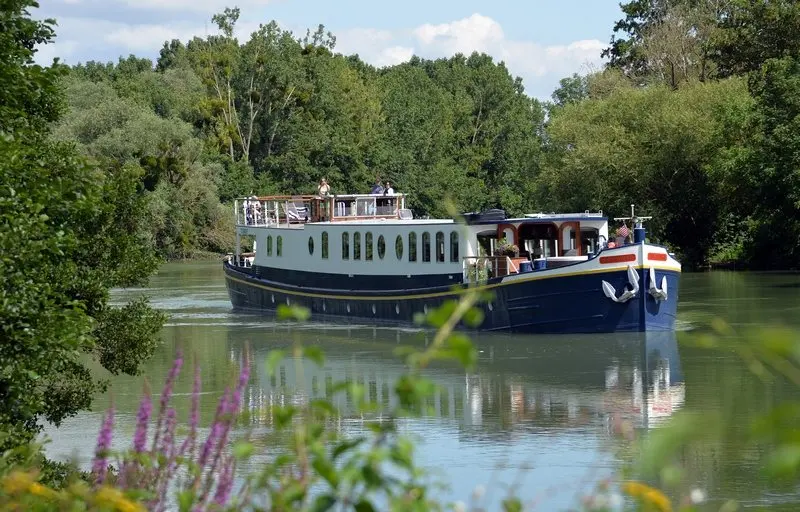
Canal barge specialist European Waterways would rather you didn't file it next to the Rhine and Danube cruise lines. Founder Derek Banks, who started the company in 1977 from a lock keeper's house on Burgundy's Canal du Nivernais, insists his hotel barges belong in a category of their own — and the logistics back him up.
The canals these barges drift along are simply too narrow and shallow for mainstream river ships. Lock dimensions rule out anything bigger, which is why, as Banks puts it, you can't squeeze 100 passengers into Burgundy this way. It's a built-in shield from the crowding that grows on Europe's big rivers every season. He notes no competitor covers as many waterways across more than two countries in this segment.
The scale is deliberately small. European Waterways is the largest hotel barge operator in Europe, yet its 18 barges spread across nine countries carry between six and 20 guests each — from the six-berth Nymphea in the Loire Valley to the 20-passenger La Bella Vita on the Venetian Lagoon and the River Po. Barges cruise at roughly 4 knots, three to four hours a day, with a crew ratio close to one crew member per two guests. Nights are spent moored, with the focus on onboard dinners from resident chefs, storytellers and local entertainers.
Rates start around $5,490 per person for a week, and that covers a lot: all meals, wines, an open bar, shore excursions and transfers. Bookings split about evenly between whole-barge charters (popular for family groups and celebrations) and individual cabins.
Banks argues the company was doing "experiential" travel decades before it became a marketing buzzword — his example is lunch with a countess in her own kitchen. That kind of access to private châteaux, vineyards and villages is the core pitch: slow travel, tiny numbers, and an itinerary no big ship could physically follow.
Looking ahead to 2027, the outlook is healthy. Bookings dipped briefly during the escalation of the Iran situation earlier in the year but have fully recovered. Expect prices to rise around 6 to 7 percent next year on higher fuel costs, though demand remains solid. The company has also just added a new Brittany canal itinerary in France and expanded its Burgundy programme.
For travellers, the takeaway is clear: if big-river cruising feels too busy and mega-ships feel too big, hotel barging is the opposite end of the scale — a floating country inn that moves a few hours a day. It suits couples who want privacy, groups who can charter an entire barge, and anyone keen on food, wine and countryside over packed ports of call. Just budget for the premium and, ideally, book early for 2027 before those price increases bite.