There's a surprising answer to a common passenger question: US rules put no limit at all on the number of flights a flight attendant can work in a day. Instead, the Federal Aviation Administration caps the length of the duty day — from the moment crew report for an assignment to when they're released — and union contracts fill in the rest.
Under regulation 14 CFR 121.467, a standard scheduled duty period tops out at 14 hours for domestic flying. That includes ground time between flights, so a crew member working short 45-minute hops could stack up five or six sectors in a day, while someone on cross-country routes might do just two. In practice, most flight attendants handle two to four flights daily, and long-haul crews usually work a single sector.
The 14-hour ceiling can stretch further — but only if airlines add crew. Duty periods of up to 16 hours require one extra flight attendant above the minimum complement, up to 18 hours requires two more, and up to 20 hours requires three. The longest duties are typically reserved for ultra-long-haul international flying outside the 48 contiguous states. Rest is regulated too: after a duty over 14 hours, crew must get at least 12 consecutive hours free of all work, and everyone must have a 24-hour break within any seven consecutive days. Since an October 2022 rule change, the baseline rest after a standard duty is a minimum of 10 hours, with no reduction allowed — and many union contracts push that higher.
Union agreements are where flight counts actually get capped. Sample contract language limits duty days to six to eight flights, with no more than 10 landings. The largest union, AFA-CWA, represents nearly 50,000 flight attendants across 20 airlines, while American Airlines crew are under APFA and Southwest's under the TWU. Monthly flying is generally capped at 75 to 100 hours, with full-time crew working around 12 to 14 days a month.
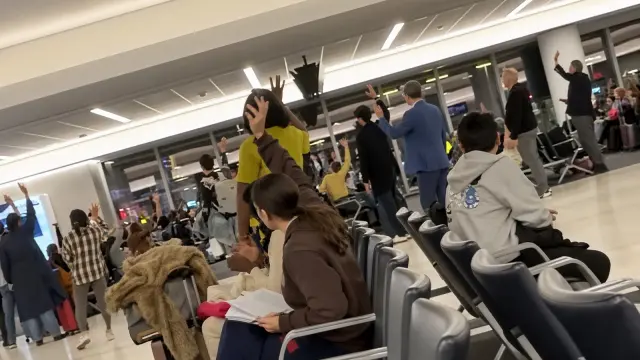
For travellers, the rules explain a familiar frustration: the crew "timing out." If a delay on the ground pushes a flight past 14 hours and one minute of duty, the aircraft legally cannot depart until the airline swaps in fresh crew — a common cause of last-minute cancellations during storms and ATC problems. There's one big exception: if a flight is already airborne and holding patterns, weather or mechanical issues push it late, the crew can legally exceed their limit to land safely. Unlike European crews under EASA rules, US flight attendants have no "commander's discretion" to plan beyond their duty limits in advance.
So the next time a gate agent blames crew duty limits for a cancellation, it's not an excuse — it's federal law, backed by rest requirements designed to keep the people in the cabin alert. Frequent flyers on delay-prone routes would do well to book earlier departures, since crews have far more slack in the morning than at the end of a duty day.