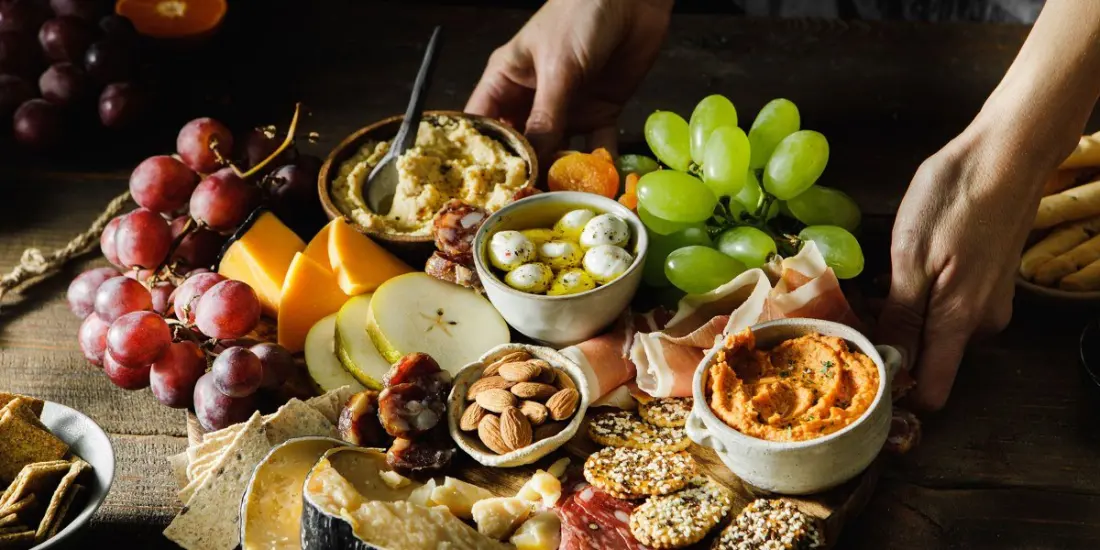
Cubed cheddar and edible flowers are out. Dominick DiBartolomeo, who took over The Cheese Store of Beverly Hills in 2022 after two decades behind its counter, has firm views on what makes a cheese board work — and his first rule is simple: let the cheese be the point. With more than 600 cheeses in the shop, he's earned the right to an opinion.
Start with variety rather than a formula. Even for two people, he'll set out five cheeses — typically a sheep, a cow, a goat, a blue and a triple crème — in small portions rather than fewer, larger wedges. Milk type alone opens up a lot of flavour range, from buttery cow cheeses to salty aged sheep's milk ones.
Quantity depends on role. If the board is the whole meal, plan on roughly three to four ounces of cheese per person; as a pre-dinner spread, two ounces will do. Then build around the cheese with charcuterie — he reaches for 24-month Prosciutto di Parma, Jamón Ibérico and Jambon de Bayonne — plus something sweet (honey, jam, chutney), mustard and cornichons to cut the richness, and nuts and dried fruit, which he prefers to fresh for both looks and quality.
Presentation matters, but not in the way Instagram suggests. He'd rather pull colour from the food itself — dried apricots, charcoal crackers, grissini — than scatter rosemary sprigs nobody eats. Skip the cubes entirely: hard cheeses like Parmesan look and taste better in rough chunks, while softer wheels can be left whole or cut into wedges and triangles. And leave soft cheeses out for about 30 minutes before serving so the flavour actually shows up; only something very runny, like an Époisses, needs less time.
For longer gatherings, pace the board. Replenish in small rounds instead of laying everything out at once, and keep backup portions chilled — the USDA's guideline is no more than two hours at room temperature (one hour above 90 degrees). For outdoor parties, non-condensing ice packs under the board help.
Finally, treat the board as a small adventure. The shop imports directly, so DiBartolomeo nudges regulars toward producers they'd never find on a supermarket shelf — a Tuscan sheep's milk pecorino scented with wild fennel pollen, or a triple-cream Brie beyond the usual label. His trick: start from something you already like and branch one step sideways.
For travellers, the store itself is worth a detour if you're in Los Angeles — a nearly 60-year-old specialty shop where the staff will actually talk you through a tasting before you buy. And even if you never visit, the takeaways travel well: buy small amounts of many cheeses, serve them at room temperature, skip anything on the board you wouldn't eat, and never show the bottom of the platter.