Most visitors to the Kruger National Park come for lions and elephants. But along the shaded stretches of the Sabie River, near Skukuza and Lower Sabie, there's a far subtler prize: the African finfoot, one of southern Africa's most elusive waterbirds.
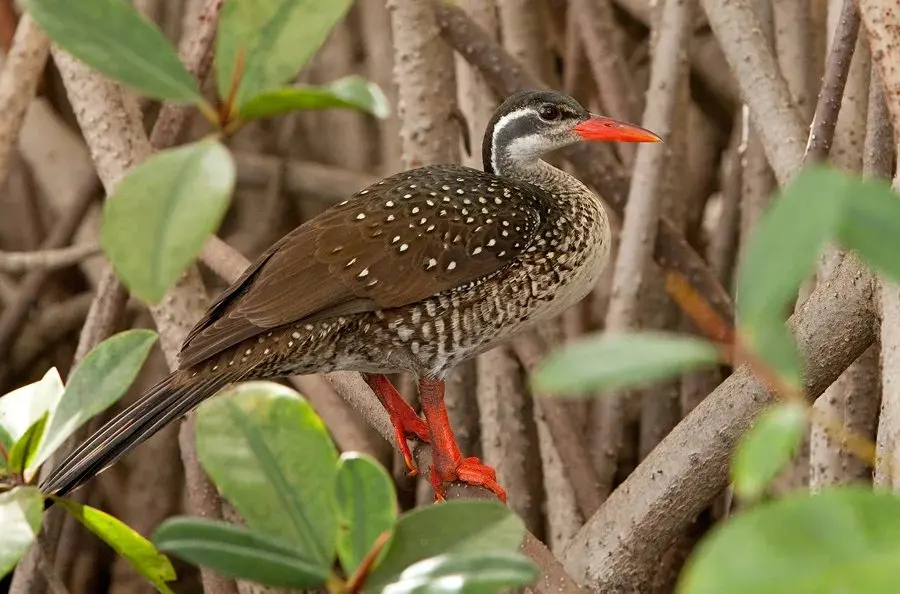
The finfoot (Podica senegalensis) is about the size of a Reed Cormorant, with a coral-red bill, salmon-orange legs and oddly large, lobed feet built for life along riverbanks. Males are darker; females wear browner plumage with stronger facial markings. It prefers clear, permanent rivers choked with vegetation, and rather than venturing into open water, it hugs the banks hunting aquatic insects, crustaceans, small fish and amphibians. Shy and naturally scarce, it's easy to miss even in perfect habitat.
The classic search route is the H4-1 tar road between Skukuza and Lower Sabie, which tracks the river with several pull-off points. Birding guides single out the high-level bridge just east of the Sabie and Sand river confluence as one of the park's best finfoot spots. Nkuhlu Picnic Site, set right on the water, is another solid stop. For a quieter option, the gravel Salitjie Road (S30) follows the river's northern bank past secluded pools where the bird is sometimes seen. The technique is simple: scan the shaded edges, especially where branches hang low over the water, and watch for movement near the bank rather than expecting anything out in the open.
There's a conservation angle too. BirdLife South Africa's 2025 Red Data Book now lists the species as Vulnerable in South Africa, Lesotho and Eswatini, with fewer than 1,000 mature individuals estimated across the region, though globally it remains Least Concern. Clearing of riverine vegetation, water extraction, siltation and pollution all squeeze the habitat it needs, and regional reporting rates are declining. Protecting rivers like the Sabie matters as much as protecting the bird itself.
For anyone planning a search, Skukuza and Lower Sabie both make convenient bases with rest camps, shops and accommodation inside the park. Bring binoculars for scanning the banks, a zoom lens for photos that don't require you to creep closer, and check recent sightings reports or ask local guides where the bird has been showing. Don't expect a guarantee: you could drive the river several times and draw a blank. Stay at designated viewpoints and resist the temptation to approach the bank for a better shot.
That's partly the appeal. Chasing a finfoot shifts your attention from the Big Five to the quieter life along Kruger's waterways — herons, kingfishers, riverine trees and shaded pools. And if one of those strange red-billed birds finally slips out of the vegetation, you'll have earned a sighting most Kruger visitors never even knew to look for.
Thanks to Getaway South Africa for the original reporting.