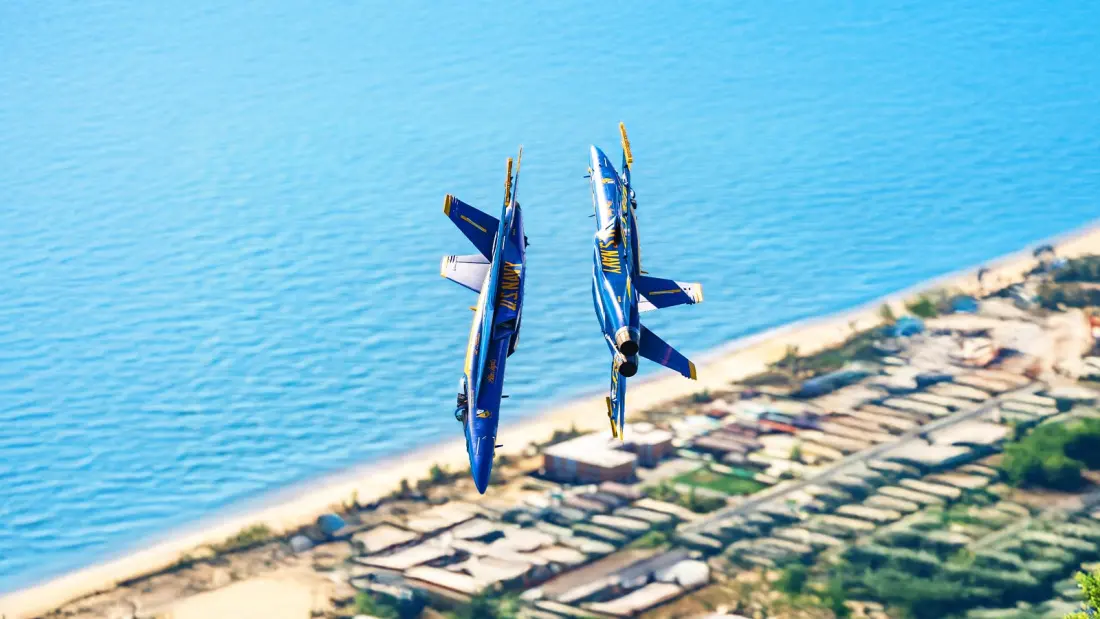
The Blue Angels fly four F/A-18s in formation with as little as 12 to 18 inches (30-45 cm) between wingtip and canopy, at speeds ranging from roughly 120 mph to 700 mph. No autopilot trickery is involved. Wingmen ignore their instruments entirely and stare at a single visual cue on the lead jet — a rivet, or a paint stripe — making constant micro-adjustments to stay locked in the diamond.
A big part of the secret is a modification unique to the team's jets: a deliberately heavy spring on the control stick, so turbulence can't jar the flight surfaces. Pilots brace their right forearm hard against their right thigh to steady their hand against that stiff tension. They also fly without inflatable G-suits — the suit's expanding bladders could nudge a pilot's arm at the worst possible moment. Instead, under a Department of Defense waiver, they fight blackouts with a punishing muscle-clenching and breathing technique, tuned through hundreds of winter training flights.
The closest flying happens in the Diamond 360, a flat, continuous banked turn. Because nothing is climbing, rolling or changing speed, the G-forces stay constant and the airflow smooth — the only scenario where the leader can safely radio "take it in," signalling the wingmen to compress into the tightest 'Yankee Set' spacing. The margins are real, though: in August 2019, during a practice run at NAS Pensacola, a wingman's canopy briefly touched the lead jet's wing. Nobody was hurt, the inspection found only a scratch, and the team still made that weekend's Chicago Air and Water Show.
The team switched from legacy Hornets to the bigger, more powerful Super Hornet for the 2021 season, ending a 34-year run with the older jets (which had themselves replaced the A-4 Skyhawk in 1986). Engineers carefully preserved the heavy stick feel, and pilots spent months reworking the diamond, solo and delta routines so the larger 'Rhino' could hold the same 18-inch gap. Safety hasn't always held: a 2007 crash near Beaufort, South Carolina — blamed on spatial disorientation under 6 Gs, with the team's G-suit waiver found to have lapsed — led the Navy to double down on physical conditioning rather than reinstate the suits.
For travellers, 2026 is a landmark year: the team's 80th anniversary season. Training happens each January at NAF El Centro, California, though security-driven cancellations there and at NAS Lemoore scrapped the usual public debut this year. The season wraps at the Homecoming Air Show at NAS Pensacola on 6 November 2026 — a good spot to check that famous spacing yourself by watching where the wingmen's canopies line up against the lead jet's wings.