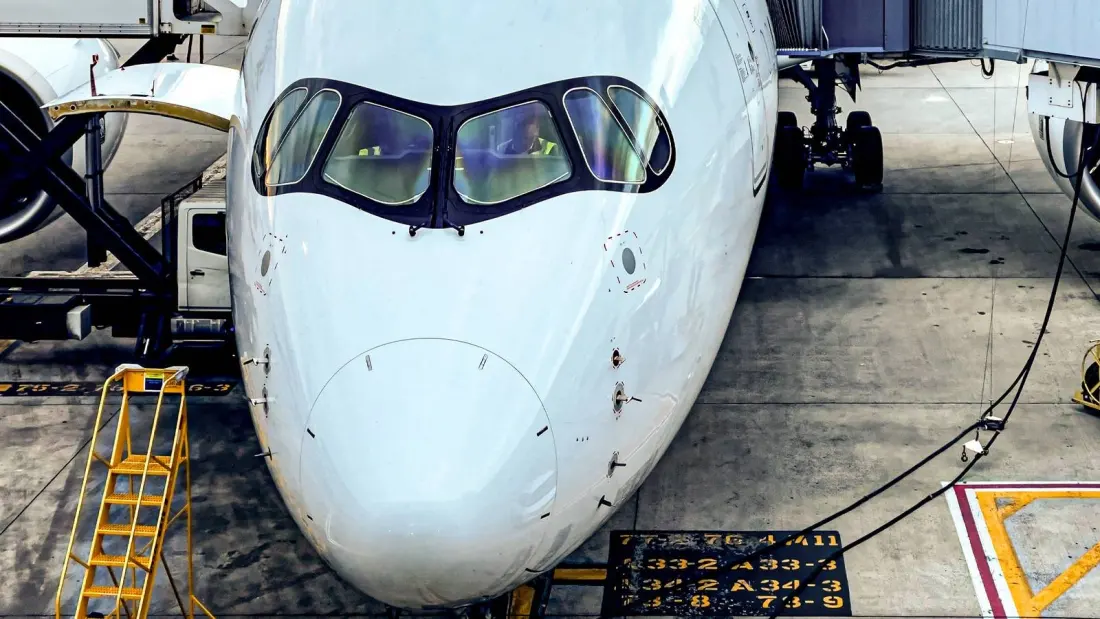
Singapore Airlines' nonstop from Changi to New York JFK is one of the longest commercial flights in the world — around 9,537 miles and up to 19 hours 15 minutes in the air. What passengers never see is the operation happening above and behind them: a second shift of crew, asleep in purpose-built bunks, waiting to take over.
The staffing alone tells you this isn't a normal flight. SQ24 carries four pilots — two captains and two first officers — plus 13 cabin crew, sometimes 14 on sectors to Los Angeles. A typical international flight manages with two pilots and eight or nine attendants. The extra bodies are not generosity; they're arithmetic. Duty-time rules make it impossible for one set of crew to work a flight this long, so the roster is built around rotating rest from the moment the doors close.
The sleeping arrangements are the interesting part. Flight attendants rest in eight curtained bunks at the rear of the aircraft, reached by a small staircase near the fourth set of exit doors — closer to a sleeper train compartment than anything in a cabin. Pilots get their own compartment above the forward business class cabin: two beds and an armchair. Pilots receive at least two rest periods, one of at least four hours, of which a minimum of three must be spent fully horizontal. Cabin crew get roughly four to five hours depending on duty length. NASA research on in-flight bunk rest supports the approach, finding that lie-flat sleep measurably improves crew alertness and performance afterwards. On a duty day that can stretch to 22 hours, the bunk is effectively safety equipment.
The choreography is simple: everyone works the first meal service, then about half the cabin crew rotate into the bunks, swapping every two to three hours so the cabin is never short-handed. In the cockpit, one pair flies while the other sleeps, switching partway through cruise.
Rest doesn't stop at landing. Pilots must have 48 hours off before departure and get a three-day layover in New York to recover from crossing 12 time zones. The aircraft helps too: the Airbus A350-900ULR's carbon-fibre fuselage allows a lower cabin altitude of about 5,900 feet and higher humidity, and its LED lighting can simulate natural sunrise and sunset to help bodies adjust.
There's history here. The route first ran from 2004 to 2013 with the fuel-hungry A340-500 and collapsed when fuel prices rose. It returned in 2018 on the A350-900ULR, which carries roughly 43,600 gallons of fuel — about 6,300 gallons more than a standard A350. The cabin reflects the same trade-offs: just 161 seats (67 business, 94 premium economy, no economy or first), because every bunk and every litre of fuel displaces revenue space. Singapore Airlines judged rest worth the sacrifice.
For travellers, this matters beyond trivia. Flights are stretching toward 20 hours — Sydney to London is next — and the standard Singapore Airlines has set, four pilots, eight bunks and three guaranteed horizontal hours, is likely to become the benchmark every ultra-long-haul operator is measured against. If crew fatigue management matters to you when booking a marathon flight, this is the checklist to look for.