
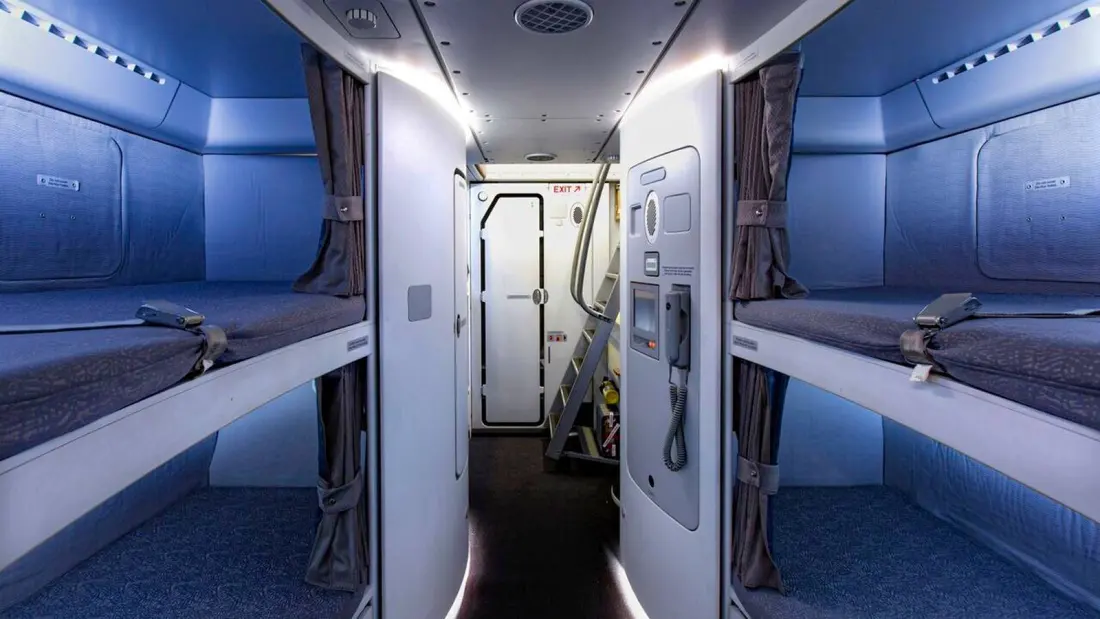
The Airbus A380 looks like a two-deck aircraft, but there's effectively a third level most passengers never see. Hidden below the main floor sits a dedicated cabin crew rest compartment — typically a 12-berth bunk module — where off-duty crew can lie flat and genuinely sleep on flights that can run up to 17 hours.
The rest area is deliberately discreet. From inside the cabin, the entrance looks like an ordinary service door; on many configurations it's near a stairway mid-economy, between rows 65 and 66. Behind it, a steep, narrow stairwell drops into a windowless bunkroom. There's even an escape hatch concealed under a passenger seat in case the normal door can't be used — evidence that this space is treated as part of the aircraft's safety architecture, not a perk.
Inside, the bunks are functional rather than plush: padded mattresses in individual compartments, sound-dampening curtains for privacy, reading lights, power outlets, a mirror, and hooks to stop loose items sliding around. Oxygen masks, seat-belt indicators and an intercom are built in, since resting crew still need to be reachable mid-flight. Some layouts also include a private crew restroom. It's compact and claustrophobic by most social-media verdicts, but it does the job.
Pilots get their own facilities, usually at the front of the aircraft near the cockpit, often with an armchair and more headroom — better suited to deep rest before returning to the flight deck. Airlines can rearrange all of this: Emirates famously gave up the forward pilot-rest space for extra passenger lavatories and moved flight crew rest down below deck with the cabin crew.
The bunkroom is only half the story; the other half is scheduling. On a typical ultra-long-haul A380 flight there might be 21 cabin crew and three pilots looking after 400-plus passengers, so rest is rotated in carefully choreographed shifts. Pre-flight briefings assign zones and responsibilities, and handovers cover who owns the galley, the call bells and any passenger follow-ups. Depending on the airline and route, crew get roughly four to six hours of break per rotation, so the cabin is never left short-handed.
Why should a traveller care? Because rested crew are safer crew. Rotation systems exist so the people handling turbulence, medical events or an emergency aren't the same ones who've been on their feet since boarding. You don't need to know where the secret door is to benefit from it — but it's a nice reminder that the calm service at hour 14 of a long-haul flight is backed by a small dormitory doing quiet work beneath your feet. It's also one reason the A380 remains a favourite among the people who actually work on it. — Simple Flying