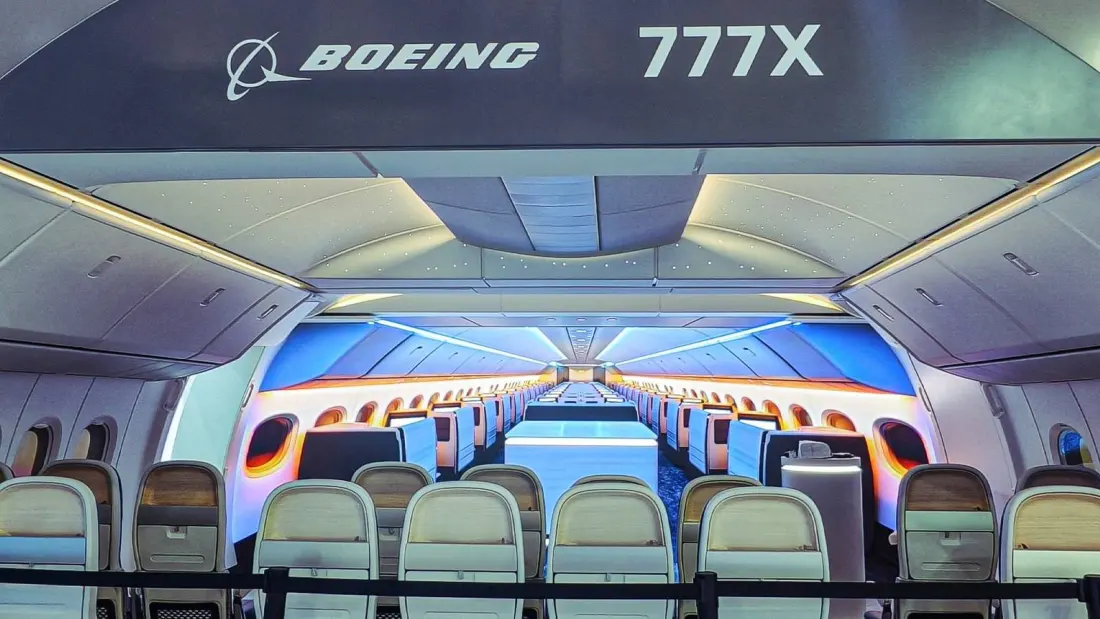
Every long-haul widebody hides a secret room. On the Boeing 777X, it sits in the crown above the passenger cabin, reached through a concealed door and a steep staircase — and unlike on most aircraft, its occupants may now be up there during takeoff.
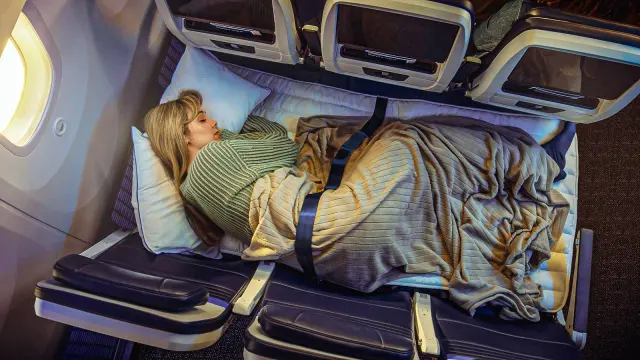
Crew rest areas come in three FAA classes: dedicated bunks, lie-flat business class seats, or curtained reclining economy seats. On the 777X, pilots get an overhead compartment with two bunks and two seats, enough room for four crew members to rotate through rest shifts on ultra-long sectors. Cabin crew get a rear compartment with ten bunks, often arranged one-above-the-other or split by an aisle in a so-called coffin layout. Blankets, pillows, reading lights, temperature controls, power outlets, uniform hooks and intercoms come as standard, and every bunk has a seatbelt.
What sets the 777X (and the 787-8) apart is certification. On most aircraft, these spaces must be empty during taxi, takeoff and landing. Under FAA special conditions, the 777-9's overhead pilot rest area can now be occupied during those critical phases — but only in the seats, never the bunks. That approval came with strings: an emergency evacuation hatch opening into the main cabin, oxygen masks everywhere including the lavatory and sink area, smoke detection and a fire extinguisher, plus new documentation alerting airport fire crews that the compartment might be occupied during an emergency landing. Crews also need specific training to open the hatch.
Why the change? Range. Aircraft like the 777X can fly ultra-long routes with an augmented crew — extra pilots working in rotation — without a layover, and someone has to have somewhere legal to sit and sleep.
The rest of the package is familiar Boeing widebody thinking: the 787's crew door hides behind a fake overhead locker, Emirates' A380 pilots sleep above the cabin while its 12 crew bunks sit under the main deck, and the A350 pairs a cockpit-side pilot rest with six bunks at the rear.
For travellers, this matters more than it sounds. The 777X isn't due to deliver until 2027, but 682 aircraft are already on order for Lufthansa (launch customer), Qatar Airways, Emirates and Singapore Airlines. The 777-9 will seat 426 with a cabin altitude of 6,000 feet, higher humidity, larger windows and 20% lower fuel burn. Rested crews on those long sectors are a safety feature every passenger benefits from — even if they'll never see the hidden staircase.