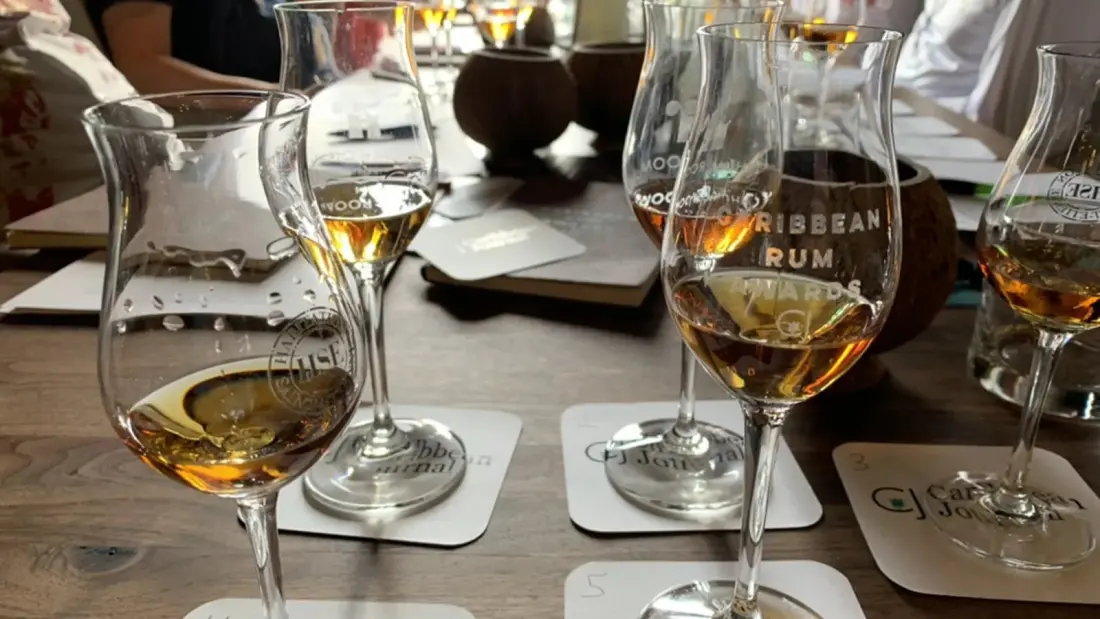
Somewhere past the twentieth glass, nobody at the table is talking. That's what judging looks like at the Caribbean Rum Awards, the only rum competition held in the Caribbean itself, staged on the small island of Marie-Galante in Guadeloupe. Every sample arrives blind, on numbered squares, so judges never know whose rum they're sipping — and the day opens with what competitors bluntly call the gauntlet.
The gauntlet is a flight of 24 to 30 white rhum agricoles, cane-juice spirits usually less than three years old, tasted back to back at strengths ranging from 45% to a frankly heroic 73% alcohol. At the top of that range a good agricole can taste grassy, green and vivid; at the wrong angle it can strip your palate and edge towards turpentine. Judges have to catch that difference on the first pass, before fatigue blurs everything into one shape.
Head judge Jose Antonio — a Miami-born sommelier and rum expert Forbes has named among the world's top authorities — describes what happens next: the first sip of aged rhum after the white flight, and the realisation that your palate isn't wrecked, it's calibrated. The whites sharpen you for everything that follows, through molasses-based flights and into the long afternoon where, around glass forty, every judge quietly questions their life choices.
The most striking moment happens off the table, in a working barn beside the copper stills of Bielle, one of Marie-Galante's standout distilleries. Fresh spirit comes off the still at 73 degrees — alcohol that should scorch — but the trick is to pour a little into your palm, wash your hand with it, and smell before tasting. Instead of fire, you get fragrance: the bouquet climbs through the back of the throat into the nose, and the burn you braced for never arrives. It's a tasting ritual worth borrowing from any distillery that will let you.
For travellers, this is the fun of the piece: rhum agricole is one of the French Caribbean's great regional drinks, made from pressed cane juice rather than molasses, and Marie-Galante is one of the best places on earth to taste it at the source — small distilleries, working cane fields, ferries from Guadeloupe. Even if you never judge a competition, a distillery-hopping day here puts you inside the same glasses the judges face, minus the forty-glass endurance test. Expect a jury of professionals who take it seriously, then celebrate loudly with cigars a few hours after the final scores — swearing off rum, briefly, every single year.