In July 1916, three brothers from coastal New South Wales walked into the worst 24 hours in Australian military history. Samuel, James and Eric Wilson had trained together, sailed to Egypt together and been posted to the same unit, the 53rd Battalion, before shipping out to northern France. On 19-20 July 1916, at the village of Fromelles, two of them were killed and the third critically wounded.
The battle was a diversionary attack meant to keep German reinforcements away from the Somme, and it went wrong from the start. Troops were sent across open ground in daylight against concrete bunkers the artillery had failed to crack, behind belts of barbed wire. More than 5,500 Australian casualties were counted in under a day, with no strategic gain. The news reached the Wilsons' parents in Port Macquarie in a brutal sequence: word that one son was wounded on the Friday, another missing on Monday, then a telegram that evening confirming a third had been killed. Young Eric, who had signed up at 17 with his father's permission, was later confirmed dead. Their mother, the family believed, died of a broken heart.
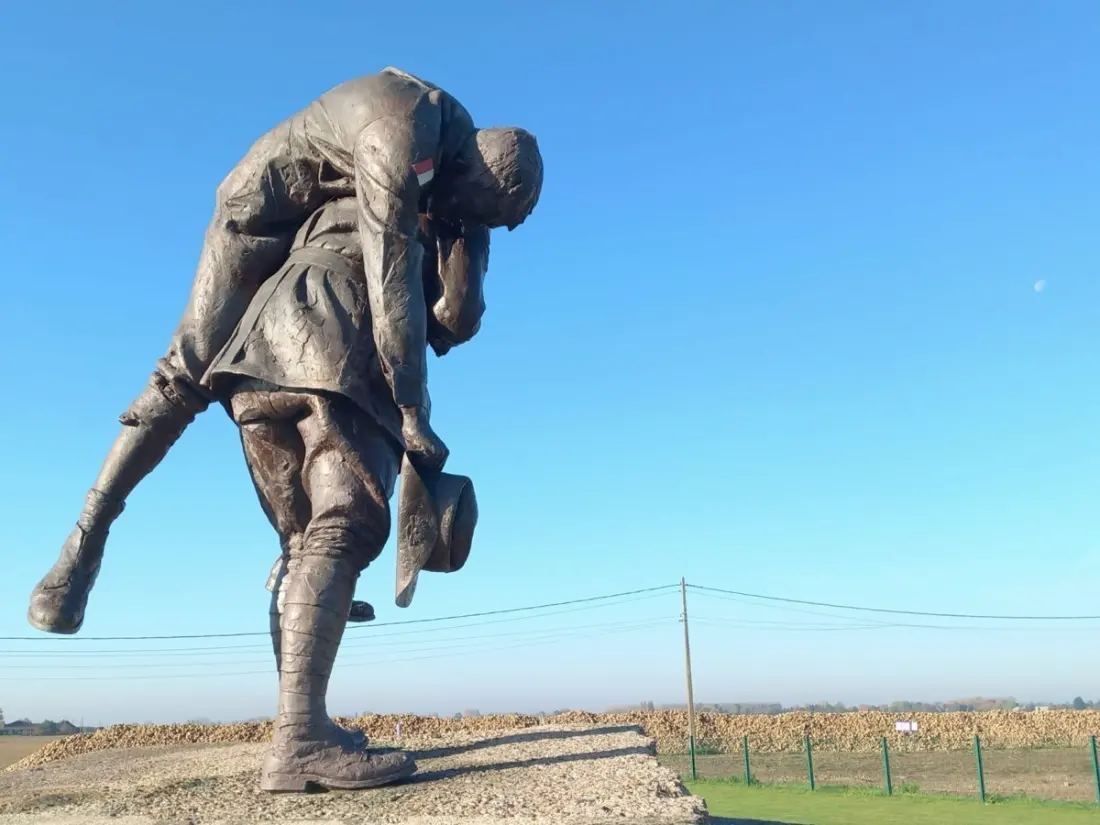
Fromelles left another legacy: the 'cobber' legend. In the days after the assault, Australian soldiers crawled back into No Man's Land to carry wounded mates out on their backs, answering cries of 'Don't forget me, cobber'. That mateship is commemorated in Peter Corlett's bronze sculpture Cobbers at the Australian Memorial Park, depicting Sergeant Simon Fraser carrying a wounded soldier. The site sits quietly in working farmland today, with the VC Corner Australian Cemetery nearby, a collective grave holding more than 400 unidentified Australian soldiers.
The story is still being written. Mass graves at Pheasant Wood, discovered in 2008, yielded the remains of 250 British and Australian soldiers, and forensic anthropology plus DNA matching with living relatives has since named around 181 of them. The Museum of the Battle of Fromelles in the village explains both the battle and this remarkable identification project, and the Wilson brothers themselves were eventually identified and reburied side by side.
For travellers, Fromelles is one of the most moving day trips from Lille. Trains run from Paris or Brussels to Lille, then it's a short taxi ride, an Ilévia bus from Saint-Philibert metro station, or a 15-20km e-bike ride along flat memorial trails through the Weppes countryside. Whether you're tracing a family connection, interested in WWI history, or simply want to understand why this small French village looms so large in Australian memory, it repays the effort.