
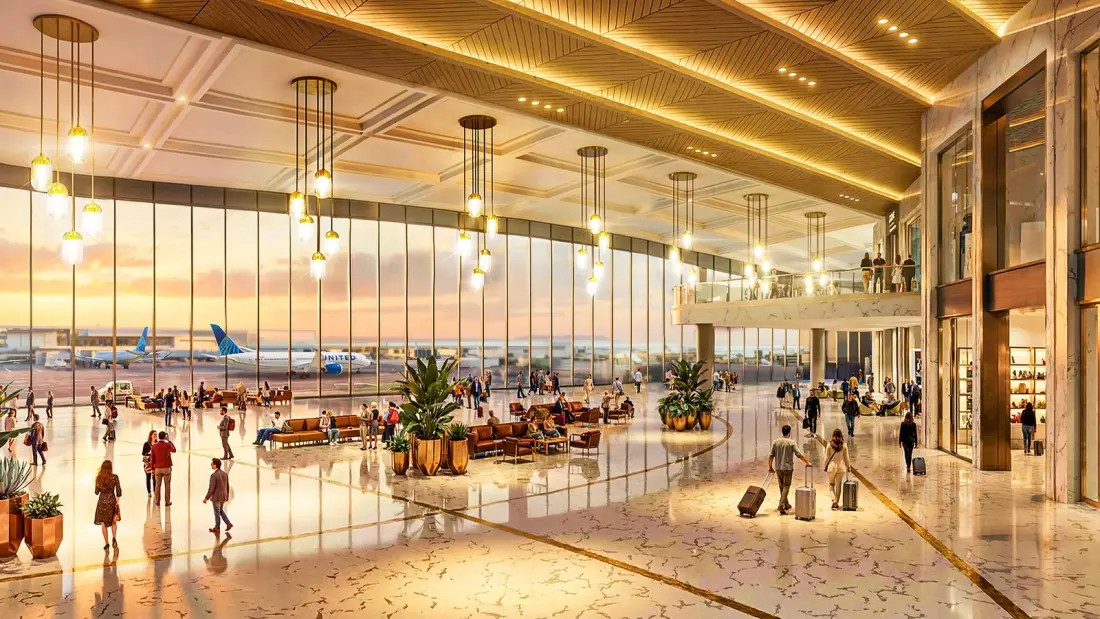
Washington Dulles is about to look very different. The airport has signed off on roughly $20 billion in upgrades, starting with a brand-new concourse opening this September and running through a full refurbishment of its iconic main terminal by the mid-2030s. For anyone flying United — which accounts for nearly 70% of the airport's traffic — the changes will reshape the travel experience over the next decade.
The first milestone is Concourse E, a 435,000-square-foot building adding 14 gates for United's domestic and international flights. Cleverly, it was built from scratch above an existing AeroTrain station on land reserved for exactly this purpose, so its roughly $500 million construction barely disturbed day-to-day operations. It will also house a new 40,000-square-foot United Club lounge, a welcome perk for premium travellers.
That matters because Dulles is bursting at the seams. It handled 29 million passengers last year — up 6.4% and the fastest growth of any large US airport — despite infrastructure that was designed for six million. Concourses C and D, which United relies on heavily, opened in 1985 as a temporary fix and are still standing 41 years later. The master plan eventually adds 36 gates across nine concourse areas, up from five today, with forecasts projecting a 78% jump in departing passengers by 2045.
The rollout is deliberately phased: one facility goes live before another is torn apart, so capacity should keep pace with demand. After Concourse E, the big-ticket item is a $6.2 billion main terminal refurbishment running from 2027 to around 2034, bringing upgraded ticketing, new TSA and Customs facilities, and international gates in the main building. An expanded underground AeroTrain and walkway network will link everything — and finally retire the airport's famous Mobile Lounges, the bus-like people movers that have shuttled passengers to planes since 1962.
For travellers, the near-term takeaway is simple: Dulles is growing fast and United's transatlantic hub is only getting bigger, with more gates, a flagship lounge, and smoother connections on the way. Expect occasional construction hoardings over the coming years, but the airport's whole strategy is built around avoiding disruption. If you're connecting through Washington on a United international itinerary, the experience should steadily improve rather than degrade — and by the 2030s, the Mobile Lounge ritual will be a piece of aviation history.