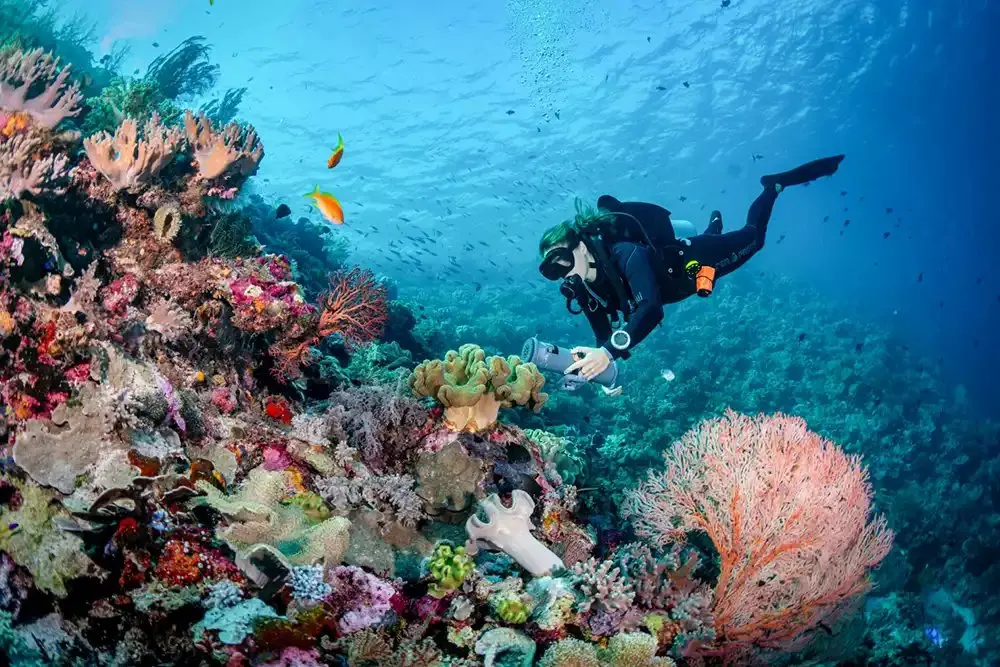
While coral-planting projects dominate the headlines (and Instagram), one Indonesian dive resort has spent 30 years proving that the most powerful conservation move can be simply keeping a reef intact. Wakatobi, in Southeast Sulawesi, has been run since the mid-1990s on a philosophy its team sums up plainly: protect what already works, cut the pressures, and let nature rebuild itself.
The numbers behind that approach are substantial. Wakatobi's Collaborative Reef Conservation Program now covers more than 70km of coral reef, secured through agreements that pay local communities for protecting reefs rather than fishing them. The operation employs over 450 people, including former fishermen who have switched to safeguarding the very waters they once worked. Tourism funds the whole arrangement, and the resort's famously healthy House Reef, where guests swim over clouds of redtooth triggerfish at dawn with bumphead parrotfish and green turtles below, is the visible proof.
Writing in Dive Magazine, Wakatobi marketing team member Bailey Anderson contrasts this with the more photogenic model of coral gardening, popularised by outfits like Coral Gardeners. That work is genuinely inspiring, but resident marine biologist Julia Mellers points to the scale problem: a 2020 review of over 350 restoration case studies found a median restored area of just 100 square metres, with most projects monitoring results for under 18 months. Manual restoration, she argues, is orders of magnitude too small to maintain an intact reef, and it works best as a complement to protection, never a substitute.
Mellers also flags the trap of 'paper parks', areas declared protected on paper while fishing pressure continues unchecked. Real protection needs monitoring, funding and community buy-in, which is exactly what Wakatobi's economic model builds in. Biodiversity matters here too: a reef rich in species has more ways to recover when disturbance hits, and that resilience can't be replanted piece by piece.
For divers, the takeaway is practical. Where you spend your diving budget is a vote, and resorts that channel tourist money into genuine, enforced protection are sustaining reefs that stay spectacular for decades, as returning guests like Kaye Richardson, who first visited in 2007, can attest. Wakatobi remains a remote, premium trip, typically reached via Bali, with options ranging from standard packages to the Courtyard Residence, a private villa setup with its own team, chef and boat for families or small groups who want to dive on their own schedule.
The story's simplest lesson may be the most useful one for anyone who loves the underwater world: the best reef you'll ever dive might be one where conservation succeeded precisely because nobody intervened.