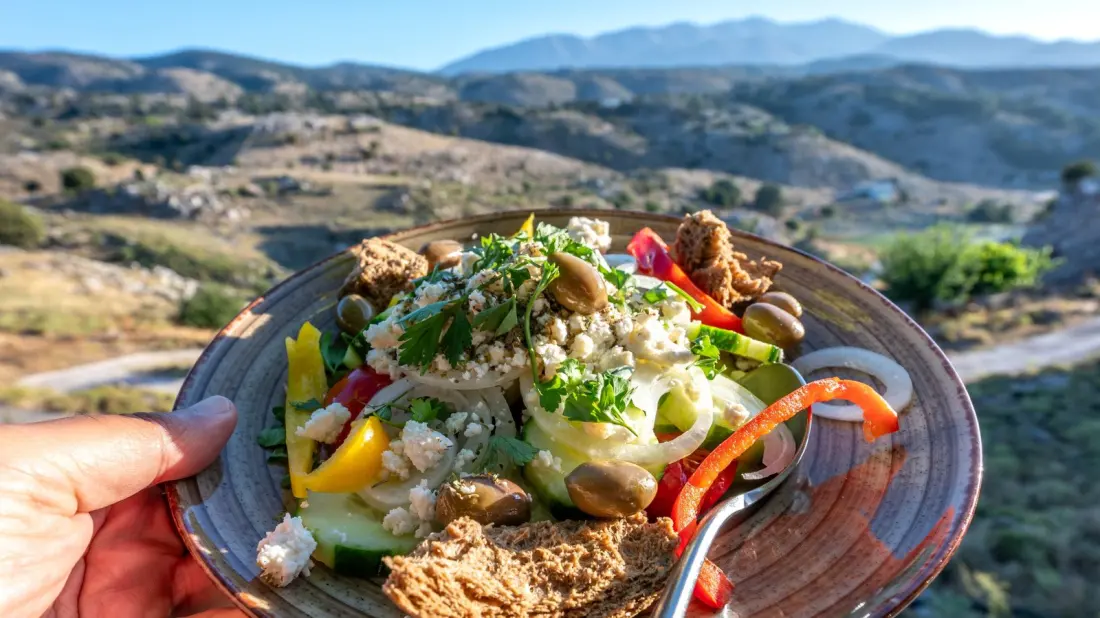
Athens gets the headlines, but Greece's largest island has quietly built a stronger case for food travellers. Food & Wine calls Crete the culinary capital of Greece, and National Geographic named it one of the world's 15 best food destinations for 2026. That's a serious claim for an island best known to many for beaches and Minoan ruins.
What sets Cretan food apart is how little it has changed. The island has cooked from its own land and sea for thousands of years, and that farm-to-table habit shows up on every taverna table — starting with olive oil from ancient groves, which locals treat as liquid gold and travellers now come specifically to taste. Though Crete isn't officially a Blue Zone, its diet and Mediterranean lifestyle closely resemble Ikaria's, the Greek island famous for residents who routinely live past 100.
The dishes are simple but distinct. Dakos — crunchy barley rusks topped with ripe tomato, olives and feta — is the classic starter. Apáki, a herb-spiced smoked pork, shows the island's older preservation techniques. Cheese from free-roaming sheep and goats carries a nutty, creamy depth you won't find in supermarket feta. Adventurous eaters should try kohli bourbouristi, snails cooked in their shells with herbs and washed down with raki, the island's signature spirit. Fresh seafood is on the menu year-round.
The food is only half the pitch. Crete's tavernas come with scenery Athens can't match: turquoise-water seafood spots along the coast, mountain village kitchens looking out over the White Mountains, olive groves and vineyards rolling to the Libyan Sea. Along the north coast, Rethymno, Heraklion and Chania (one of Europe's oldest cities) pack in restaurants with postcard views — one traveller on Reddit reported staying in all three towns and never having a single bad meal.
For a specific recommendation, food writer Diane Kochilas calls the drive from Heraklion up to the mountains of Sfakia in search of a cheesy Cretan pie extraordinary, with sweeping views of the Libyan Sea the whole way. On the western side near Topolia, Tavern Spiliaraki serves traditional Cretan food at fair prices from a stone building set in a green gorge — its outdoor terrace overlooks hills, valleys and mountains, and it holds a 4.8-star Google rating across more than 2,000 reviews.
For anyone planning a Greece trip around eating well, the takeaway is straightforward: Athens is fine for a souvlaki-fuelled city stop, but Crete rewards slow travel — base yourself in two or three towns, drive the mountain roads, and eat where families have cooked the same recipes for generations.