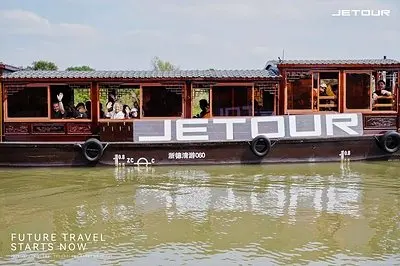
A Chinese automaker spent four days this October trying to prove a point: the car is no longer just how you get to the trip — it is the trip. JETOUR, the brand behind the "Travel+" strategy, ran its 2026 Global Technology Experience Day from 20 to 23 October under the theme "Future Travel Starts Now," splitting activities between Wuhu in Anhui province and Moganshan in Zhejiang.
The tech side was the headline act. Journalists and guests got hands-on with the XWD Fully Automatic Intelligent 4WD system, which offers 7+X one-touch drive modes for mountain roads, gravel and water crossings, plus the GAIA All-Terrain Intelligent Architecture that adapts to changing ground. C-DM hybrid technology aims to keep performance and fuel efficiency in the same package. On 21 October, vehicles fitted with these systems tackled mountain-road test drives around Moganshan, a bamboo-covered hill resort area west of Hangzhou.
The product lineup tells you who JETOUR thinks its customer is. The G700 pairs premium comfort with serious off-road ability, while the T1 and T2 are pitched at people who commute during the week and hit light trails at the weekend. The brand sells the idea of the vehicle as a "mobile third space": roof tents, onboard refrigerators and other add-ons turn the car into base camp. The event leaned into that with a camping market and a Starry Night Forum held outdoors rather than in a convention hall.
There was a conservation angle too. Participants visited Xiazhu Lake in Zhejiang for a crested ibis protection initiative — part of a wider pattern that includes JETOUR backing cheetah conservation in Africa, turtle protection in Malaysia, harpy eagle projects in Panama and efforts to save Pakistan's national animal, the markhor. The company has also tied up with Chilean football club Colo-Colo, basketball's FIBA and the Malaysia Marathon, betting that travel brands are built through culture and sport, not just showrooms.
The context: JETOUR launched in 2018, now operates in more than 100 countries and regions through over 2,000 sales and service outlets, and splits its range between the light-off-road T Series and the premium G Series. For travellers, the takeaway is that road-trip hardware is getting smarter and more camping-ready — and that overland touring in Asia, Africa and beyond is becoming a bigger part of how carmakers imagine the holiday.
Why it matters: if you rent or buy a vehicle for a road trip, features like automatic terrain modes and hybrid efficiency are moving from luxury niches into mainstream models, which changes what a self-drive holiday can look like. Whether the "Travel+" vision holds up on real trails is another matter — but the direction of travel is clear.
Story via Laotian Times.