
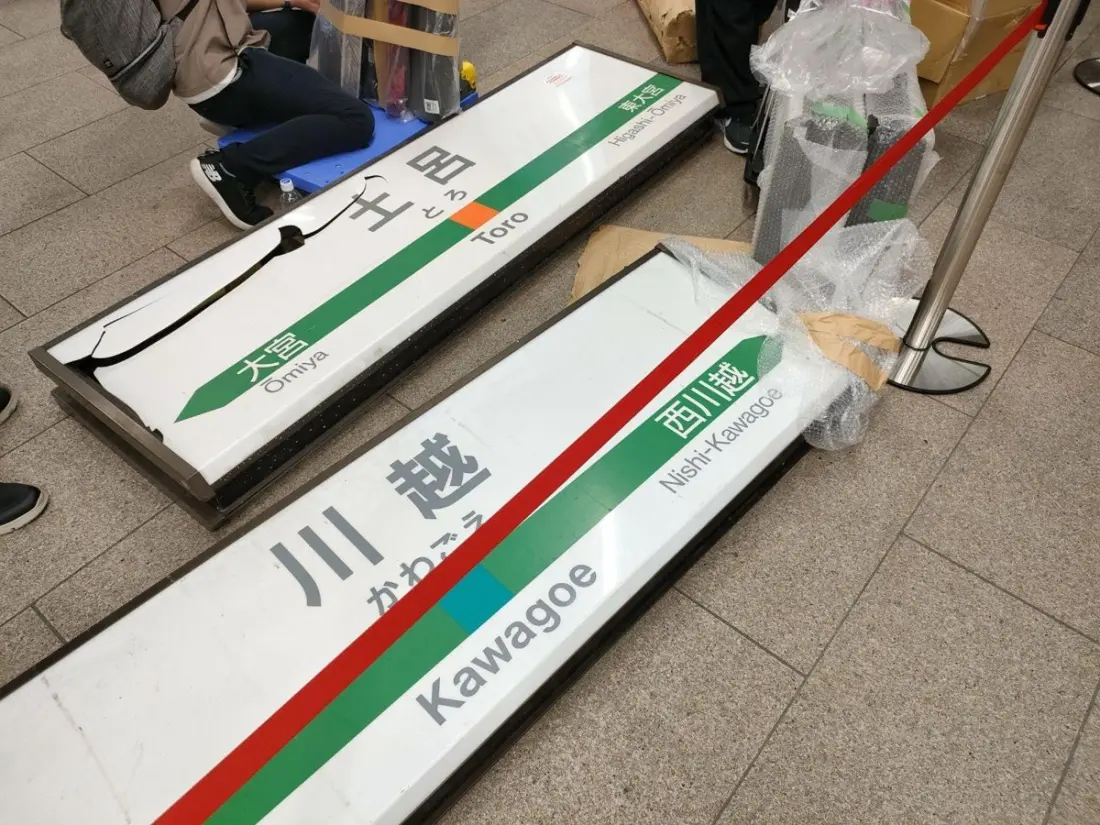
Rail fans in Saitama Prefecture recently got the kind of shopping trip most travellers never see: a JR sale event at Urawa Station where the merchandise was the station itself. Among the items up for grabs were the electric signage panels that normally hang from station ceilings, along with train number plates and other bits of genuine rolling stock and station equipment.
For anyone who has spent time on Japan's rail network, the appeal is obvious. Japanese stations are immaculate, heavily signed environments, and those glowing ceiling-mounted signs are part of the everyday scenery for millions of commuters. Owning an actual decommissioned panel, still carrying the station name or platform directions, is a far more authentic keepsake than anything from a gift shop. Number plates from trains carry similar weight for collectors — they're the identifying plates fixed to the carriages themselves, and they rarely surface publicly.
Events like this are part of a broader culture of railway fandom in Japan, where trains are followed, photographed and collected with an enthusiasm that surprises most first-time visitors. There are entire magazines, fan clubs and museum exhibitions devoted to rolling stock, and operators like JR have learned that retired hardware has real value. Rather than scrapping everything when signage is replaced or trains are withdrawn, chunks of it can be sold to the people who spent years riding past it.
Why should a regular traveller care? Two reasons. First, if you're anywhere near Saitama or the Greater Tokyo area when a sale like this happens, it's a genuinely unusual activity — you can walk away with a slab of the world's most famous rail network for a modest price, and it makes for a souvenir with an actual story. Second, it's a window into how seriously Japan treats its trains. Even a routine shopping mall-adjacent station in Saitama can become an event venue because of railway nostalgia.
Practical tip: sales like these are usually announced locally, often through JR East's regional channels or fan sites, and popular items go quickly. If you can't make an event, the Railway Museum in nearby Omiya and various secondhand markets in Akihabara and Nakano offer similar hunting grounds for transport memorabilia. Combine a visit with a ride on the lines themselves — Saitama sits north of Tokyo on the Shinkansen and conventional networks, so it's an easy half-day trip from the capital.