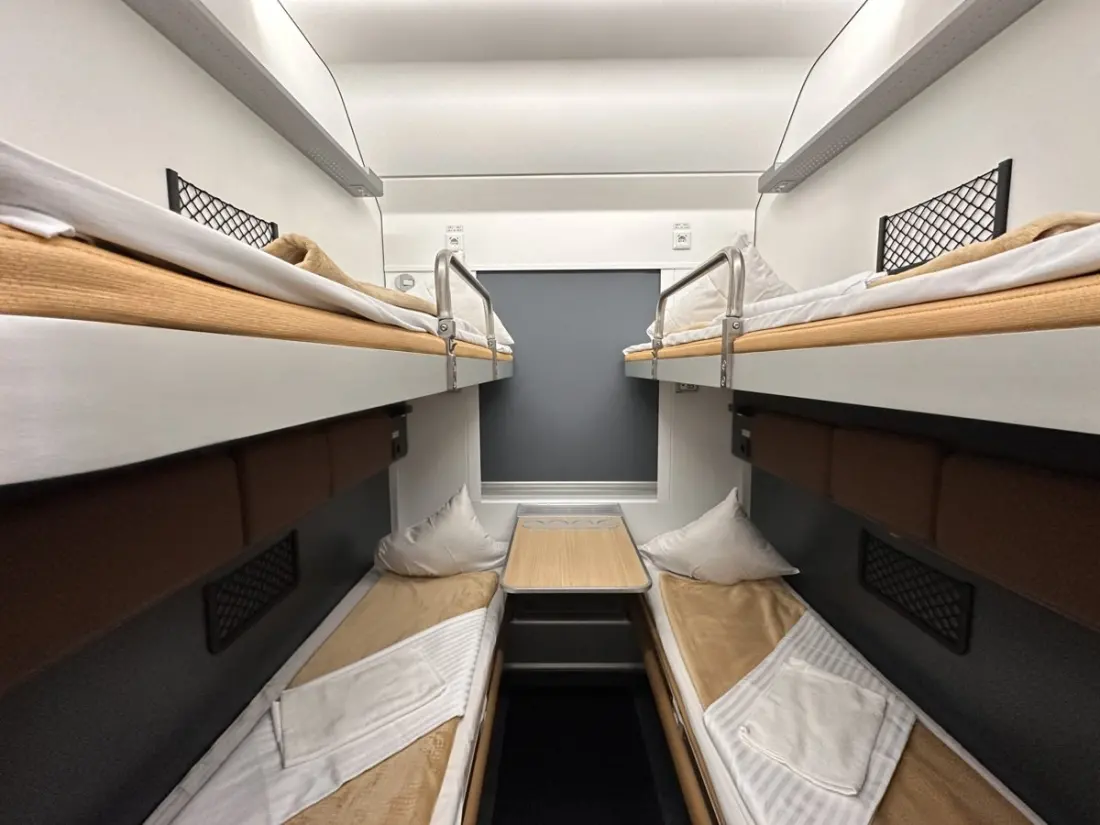
Kazakhstan's busiest rail corridor just got an upgrade. On Nov. 11, the national operator KTZ launched the country's first passenger train fitted with Stadler coaches built inside Kazakhstan, running daily between the capital Astana and Almaty — the country's largest city and cultural hub.
Train No. 3/4 departs Astana's Nurly Zhol station at 1:10 p.m. and pulls into Almaty at 8:30 a.m. the next morning, an overnight run that lets travellers sleep through the steppe rather than fly. Tickets are sold via bilet.railways.kz or at station offices.
The coaches are manufactured locally using Swiss Stadler technology, and they're built for extremes: they operate between minus 50 and plus 45 degrees Celsius, with a service life of 40 years. Each compartment gets individual temperature control passengers can adjust by a couple of degrees, plus 220-volt sockets, USB and USB-C ports, Wi-Fi, individual lighting and climate control. Compartment coaches sleep 40, open-plan sleeping cars take 58, and every train includes a buffet car, luggage space, video surveillance and facilities for passengers with reduced mobility.
More trains are coming. KTZ has already accepted over 100 coaches under a contract for 557 delivered in phases through 2030, with a second Stadler-equipped train launching on the Nurly Zhol–Semei route from Nov. 13. Officials frame the deal as both a fleet renewal and a domestic industry play, with the coaches expected to spread across major routes nationwide.
Why should travellers care? Rail is arguably the best way to cover Kazakhstan's vast distances, and the Astana–Almaty link is the workhorse route for anyone touring the country. A modern overnight train with working Wi-Fi, power outlets and a buffet beats a domestic flight once you factor in airport time — and it drops you in central Almaty ready for the mountains on its doorstep. If you're heading toward Semei in the northeast, the newer coaches will reach that route too within days of launch. For now, this is one of the more comfortable ways to cross Central Asia's biggest economy.