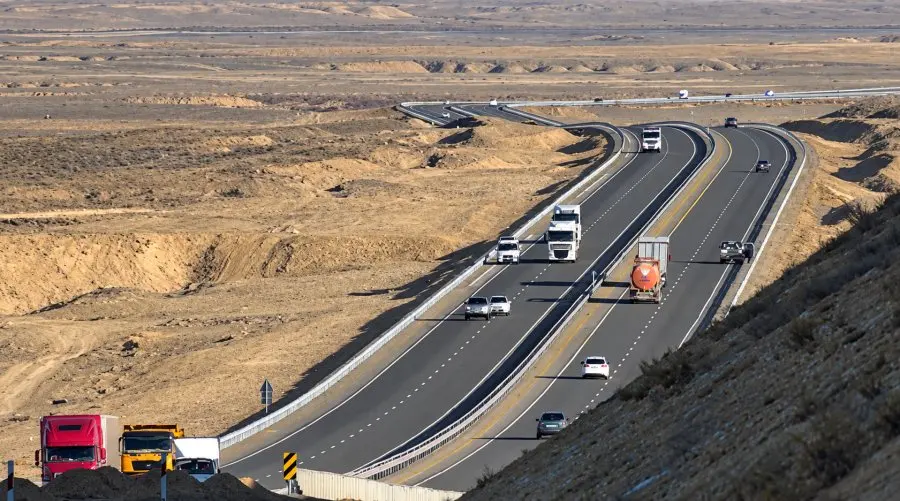
Kazakhstan is quietly rebuilding how people move around the world's ninth-largest country. Between 2023 and 2025, the government built, reconstructed or repaired more than 19,000 kilometres of roads, laid hundreds of kilometres of new rail track, and nearly doubled domestic flight capacity. For travellers, that means getting between Astana, Almaty and the far-flung regions is becoming noticeably easier.
The road numbers are striking. Work in 2026 alone covers more than 11,000 kilometres, including 3,400 kilometres of national highway construction and reconstruction. A flagship project is the 896-kilometre Center-West route, linking Astana with western Kazakhstan through Arkalyk and Yrgyz. Rural access has improved too, with 10,200 kilometres of local roads finished over three years. By the end of 2026 the government expects 95% of national highways to meet technical standards, rising further by 2029.
Rail is expanding in parallel. Around 911 kilometres of new track have been laid in five years, with 800 more under construction and 2,600 kilometres being modernised. Trains carried 60.2 million passengers between 2023 and 2025, with the busiest hubs in Almaty, Astana and Shymkent. Passenger-friendly touches include women-only carriages on 13 routes and a 50% fare discount for passengers with disabilities and their companions.
For travellers, the aviation story is the most immediately useful. Domestic airlines now operate roughly 890 weekly flights across 60 routes, up from 630 flights on 51 routes in 2023. Arkalyk Airport has reopened, launching twice-weekly subsidised flights to Astana, Almaty and Kostanai — the Astana hop takes about 40 minutes. Pavlodar's runway was upgraded in 2026, and new airports at Zaisan, Katon-Karagai and the Kenderli resort area are due to finish by the end of the year. Runway projects at Astana, Almaty, Shymkent and several other cities run through 2029.
Freight matters to travellers too, indirectly. Kazakhstan's Digital Trade Corridor links its railway systems with Azerbaijan and Georgia along the Trans-Caspian route, and a paperless customs module has cut clearance from eight hours to 30 minutes. Cargo delivery from China to Georgian and Turkish ports has dropped from 38 days to as little as 13, with a 10-12 day target ahead — a sign the overland Silk Road corridor is becoming a genuine alternative for anyone travelling that way by land.
Who should care? Independent travellers planning overland routes across Central Asia, anyone combining Almaty or Astana with remote destinations like the Altai foothills near Katon-Karagai, and road-trippers eyeing Kazakhstan's vast western steppe. The practical upshot: journeys that once required long overland slogs can increasingly be stitched together with short domestic flights, decent highways and improving trains. The infrastructure is catching up with the country's sheer scale — a process that will accelerate through the decade.