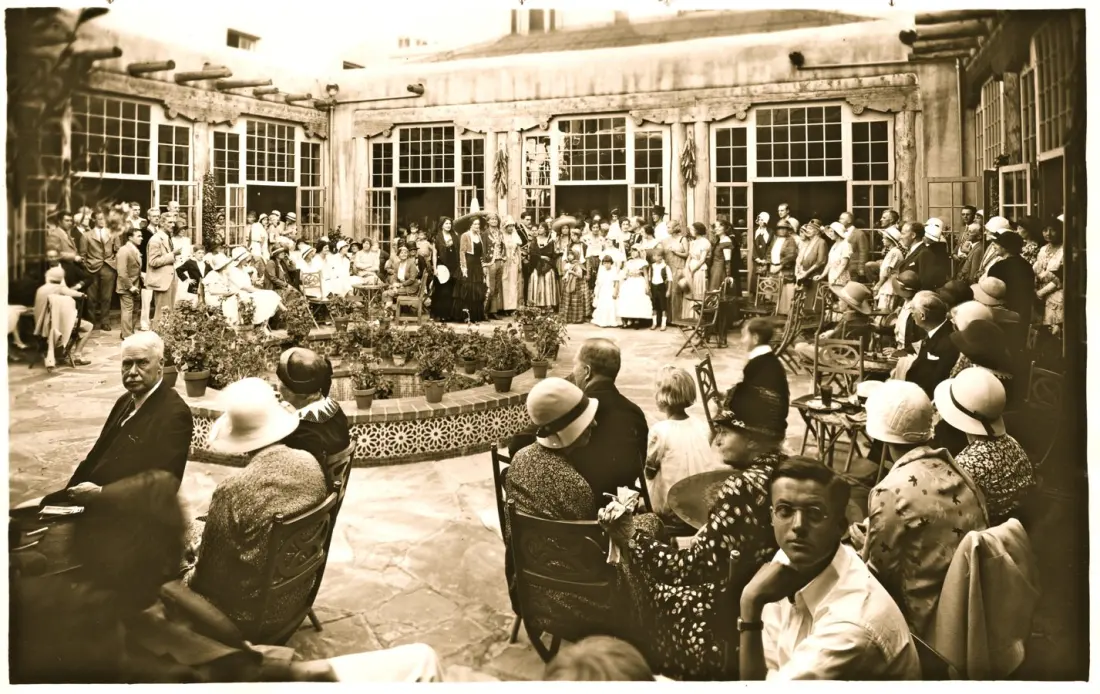
The corner plot of La Fonda on the Plaza has hosted travellers since around 1610, making it the oldest lodging site in the United States. The Santa Fe hotel's current building opened on 30 December 1922 with 55 rooms, but its road to becoming one of America's iconic historic hotels involved a two-man tank, the Fred Harvey Company, the Manhattan Project and a near-demolition.
When the tired 1840s Exchange Hotel on the site had to go, locals marked its demolition with flair: at a 1919 Victory Bond rally, anyone buying a $100 war bond could climb into a two-man tank — nicknamed the "Mud Puppy" and hauled in by train — and take a swing at smashing the old building. A citizens' corporation then sold 4,000 shares of $50 stock to raise $200,000, hiring architects Rapp, Rapp and Hendrickson to build the hotel you see today.
The railway era gave La Fonda its glamour. The Atchison, Topeka and Santa Fe Railroad bought the struggling property in 1925 for $165,000 and leased it to the Fred Harvey Company. Fred Harvey, a London immigrant who arrived in 1853 at 17, had transformed American rail travel dining after deciding the standard 30-minute depot meal — often recycled from the previous trainload — was unacceptable. His Harvey House restaurants served fresh food on fine china in half an hour, and at their mid-1920s peak the company ran more than 80 restaurants, 25 hotels and 7,000 employees, making it the world's largest franchise before Hilton, Marriott or Disney existed. La Fonda flew the Harvey flag from 1926 to 1968.
The 1940s brought spy-novel material. J. Robert Oppenheimer, who loved New Mexico, convinced the government to place the Manhattan Project at Los Alamos, 45 minutes away — and kept a temporary office at La Fonda. Contractors building the secret town stayed at the hotel through 1943–45, saving it from bankruptcy, while scientists came down on Sundays to eat, drink heavily and, reportedly, mingle with Russian and German spies. Federal agents worked undercover as bartenders and bellmen, and one-too-many drinks could earn a scientist a locked room and confiscated trousers until morning.
When the interstate bypassed the rail towns, the Harvey Company folded and La Fonda nearly met the wrecking ball. In 1968, Sam and Ethel Ballen of Dallas bought it for $1 million and spent four decades restoring it, bartering with artists to fill its walls. The result: a collection of more than 1,200 original pieces, roughly three-quarters Native American, with works in every guest room — some by students of Dorothy Dunn's 1930s–40s art school, painting the same subjects in charmingly different ways.
For travellers, this is history you can sleep in. The hotel runs a free guided tour that unpacks these stories, and it makes an ideal base for Santa Fe itself — the oldest US state capital, famous for its adobe-draped Plaza, canyon-road galleries, chile-heavy New Mexican cooking and easy day trips to pueblos, petroglyphs and the Los Alamos story just up the hill.