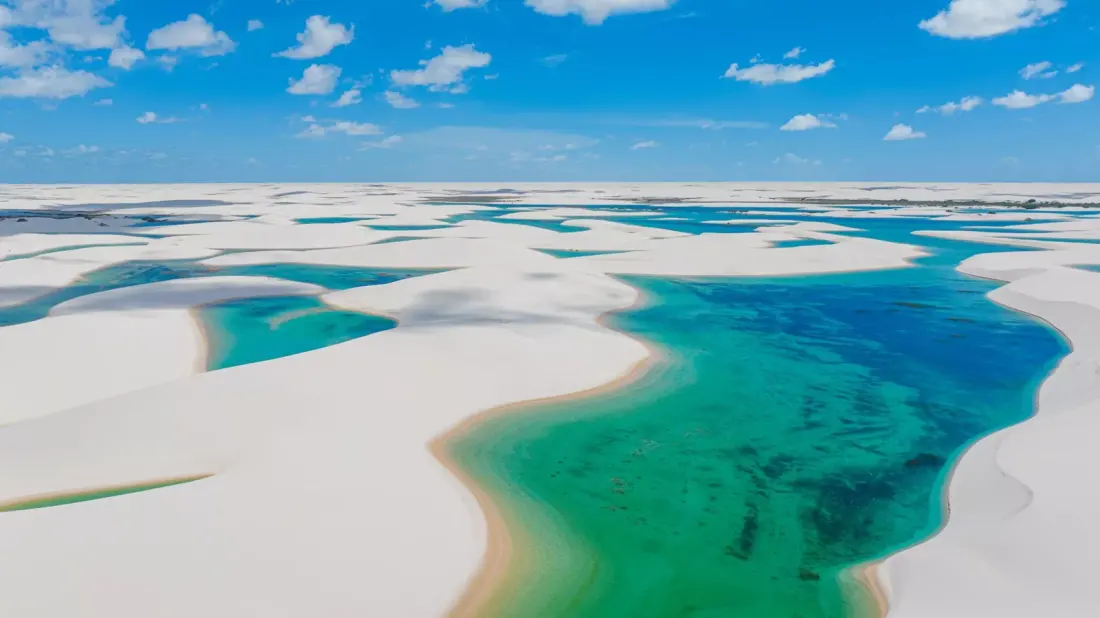
White dunes roll to the horizon on Brazil's northeastern Atlantic coast — then, for a few months each year, hundreds of clear blue and green lagoons appear between them. This is Lençóis Maranhenses, and it looks like a desert that shouldn't exist. The best part? It isn't a desert at all.
The national park, in Maranhão state, covers more than 156,000 hectares, roughly 90,000 of which are dunes. Some rise about 30 metres, sculpted by winds pushing coastal sand inland — individual dunes can migrate more than 20 metres a year. The name translates roughly as 'bedsheets', a nod to those rippling folds of white sand.
What makes the place remarkable is water. The region gets a proper rainy season, and the rain collects in the hollows between the dunes while the water table rises beneath them. The result is a temporary maze of freshwater pools — filled by rain and groundwater rather than rivers — that shrink and vanish again as evaporation takes hold in the dry months. The park also sits where the Cerrado, Caatinga and Amazon biomes meet, so those seemingly lifeless sands support mangroves, rivers and a surprising range of adapted plants and animals.
Timing matters here. The lagoons are generally at their fullest from May to September, after the rains, though conditions shift with each year's rainfall. Arrive late in the dry season and some pools may be gone entirely.
There are three main gateways. Barreirinhas gives access to the best-known lagoon areas, Santo Amaro reaches other sections of the dune fields, and Atins — a former fishing village near the mouth of the Preguiças River — has become a popular base of its own. For travellers with time and legs to spare, the multi-day Travessia dos Lençóis trek crosses the park between Atins and Santo Amaro: you walk the dunes, swim in the lagoons and overnight with local communities along the way.
The park was protected as a national park in 1981 and added to UNESCO's World Heritage List in 2024. Visitor numbers and vehicle use are regulated, so the shifting dunes and fragile lagoons stay intact. Given that the whole scene rearranges itself every year, that protection makes sense — the landscape you photograph may not look the same the next time anyone sees it.