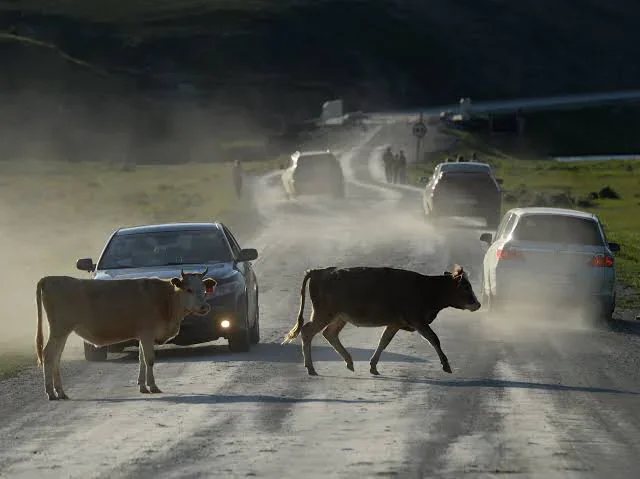
If you're planning a self-drive trip around Kyrgyzstan, there's a road hazard you might not have factored in: animals. Official figures from the country's Interior Ministry show 45 road accidents involving domestic livestock in the first ten months of 2026, killing five people and injuring 60 more.
The numbers vary sharply by region, and they map closely onto the routes travellers actually drive. Jalal-Abad in the southwest logged the most incidents at 13, with 16 people injured, followed by lakeside Issyk-Kul with 11 accidents and 14 injuries. Issyk-Kul is the country's most popular touring circuit — the ring road around the lake crosses open pasture where herds graze near the tarmac. Chui, the region around Bishkek, recorded seven accidents and two deaths, while Osh had six accidents and 10 injuries, Batken five, and mountainous Naryn three accidents including one fatality.
The Main Traffic Safety Department is calling on herders to keep closer watch over their animals, especially at night, and not to let them wander onto roads. But for visitors, the practical takeaway is simpler: expect animals on or near the highway at any hour, and drive accordingly.
Kyrgyzstan is one of Central Asia's best road-trip destinations — the 4,000-kilometre network includes dramatic passes, the Song-Kul high pastures and the southern route over the Taldyk Pass to Osh. It's also a country where semi-nomadic herding remains central to rural life, so horses, cattle and sheep crossing or grazing beside roads are a normal part of the scenery. Combine unfamiliar roads, faded markings, limited lighting outside cities and free-roaming livestock after dark, and the risk profile changes noticeably at night.
Local drivers' habits are worth factoring in too: overtaking on two-lane roads can be assertive, and speeds don't always adjust for conditions. Building in daylight driving hours, rather than pushing on into the evening, removes most of the danger window — the ministry's own advice about night-time hazards underlines that.
None of this should put you off. The accident figures, sobering as they are, are spread across a whole country and ten months, and careful driving puts you in a very different statistical position. But anyone renting a car in Bishkek or planning the classic Bishkek-to-Osh highway run should know that dodging a herd of cows on a mountain bend is a genuine possibility, not an anecdote. Slow down near villages and pasture, use high beams where there's no oncoming traffic after dark, and treat any warning about animals on the road as literal.