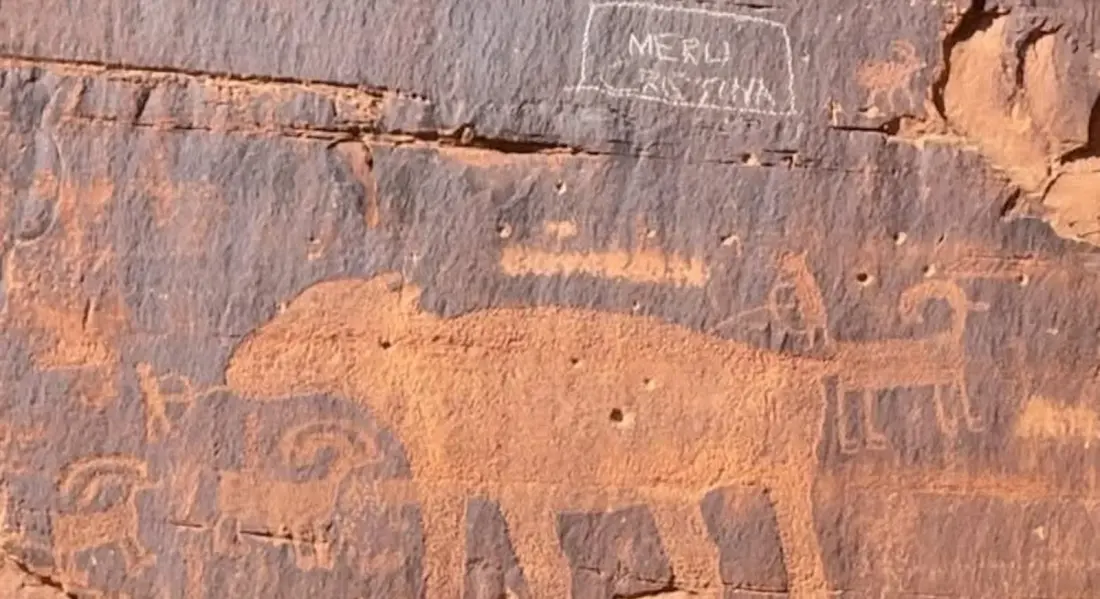
Two ancient rock-art panels near Moab, Utah, have been defaced, and the Bureau of Land Management is now hunting for whoever did it. On November 6 the agency announced it was investigating vandalism at the Bear Panel along Highway 279 near the Colorado River, and at a second site near Hell's Revenge, a popular four-wheel-drive trail in the Sand Flats Recreation Area. At the Bear Panel, the name "Meru" was scratched beside carvings of a bear and a bighorn sheep; at the other site, "Craig W" was gouged across several figures. Much of the artwork dates back around 1,500 years and comes from Ancestral Puebloan and Fremont traditions, plus more recent Indigenous communities.
The damage may be permanent. Chris Merritt, Utah's state historic preservation officer, explained that standard clean-up methods can backfire: scrubbing the stone risks harming the original carvings beneath, while at the Bear Panel a crack in the sandstone means scraping could let rainwater in, setting off freeze-thaw cycles that weaken the rock. Any repair work also has to be done in consultation with descendant tribal communities. As Merritt put it, five minutes of damage can mean weeks of careful restoration.
There are real consequences for this kind of thing. Under the federal Archaeological Resources Protection Act, vandalising protected archaeological sites carries fines up to $20,000 and up to two years in prison. In November 2025, a Utah woman who damaged petroglyphs near Wire Pass got 12 months' probation, a BLM land ban, and $14,853 in fines and restitution. The Moab cases aren't isolated either — in March 2026, Grand County sheriff's deputies investigated graffiti carved into petroglyphs near Tusher Tunnel. Merritt says rock-art vandalism has grown noticeably in scale and reach over the past five or six years, a trend he links partly to surging visitation on public lands.
Utah is responding with its Protect Our Past education campaign, a statewide network of volunteer site stewards, and physical measures like signage and fencing at vulnerable sites. Anyone with information on the Moab cases is asked to contact Moab BLM Law Enforcement at 435-259-2131.
Why should travellers care? Moab's rock-art panels are among the most accessible ancient sites in the American Southwest — you can walk up to them in minutes, no permit required. That easy access is exactly what makes them fragile. If you're heading to Arches, Canyonlands, or the trails around town, treat rock art as untouchable: look, photograph, and leave it exactly as you found it. Touching, tracing, or carving doesn't just break federal law — it erases a record that has survived two millennia and can't be replaced. Visiting respectfully is what keeps these places open to everyone.