
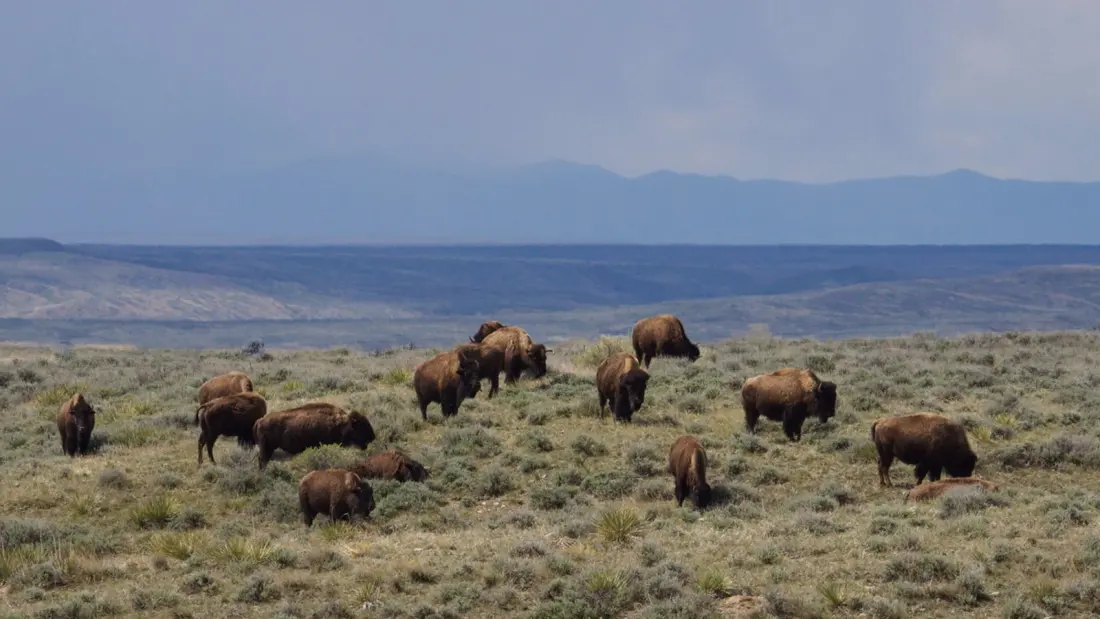
A federal judge has blocked the Biden-era-era bureaucracy's latest twist — no, scratch that — a US District Court has temporarily stopped the Bureau of Land Management from removing roughly 900 bison from public grazing land in Montana. The animals belong to American Prairie, a nonprofit reserve spanning more than 600,000 acres of private land and federal grazing leases across the state's shortgrass prairie, all of it open to the public for hiking, camping and wildlife watching.
The fight began in May 2026, when the BLM ordered the bison off three federal allotments, arguing that under a new reading of the Taylor Grazing Act, grazing permits should apply only to "production-oriented" livestock — animals raised for meat, milk or fibre. Since American Prairie keeps bison for conservation, not beef, the agency said the herd had to go by September 30. Removing hundreds of animals would have meant culling or relocating them, a scenario the organisation had already warned would be devastating.
Judge Brian Morris disagreed with the agency's logic. In his ruling, he found no statute or precedent requiring livestock operations to focus exclusively on production while ignoring conservation, range improvement or preservation. Notably, the BLM itself concluded back in 2022 that bison grazing would improve rangeland productivity and riparian health on these very lands. The preliminary injunction keeps the bison in place while the lawsuit continues, though it doesn't extend to three additional tracts where the herd doesn't yet graze.
Why does this matter beyond the courtroom? Ecologically, bison behave differently from cattle — they roam two to three miles a day, grazing lightly as they go, rather than hammering one patch bare. Research links that movement to greater biodiversity and drought resilience on native grasslands. There's also a tribal dimension: American Prairie supplies animals to tribes building their own herds, and the Coalition of Large Tribes publicly backed the preserve, telling Interior Department leadership its methods closely mirror those of tribal herd managers. Local ranching groups, including the Montana Stockgrowers Association, supported the removal order instead.
For travellers, the stakes are tangible. American Prairie is one of the few places in the US where you can camp on vast open prairie and watch a genuinely wild-scale bison herd — a landscape that once held tens of millions of the animals and now holds them almost nowhere. The uncertainty already pushed the organisation to cancel its 2026 public bison harvest, and a final loss could reshape both the land and the visitor experience. If you've ever thought about seeing Montana's high plains before they change, this ruling buys the prairie — and its bison — some breathing room.
Story via Outside Online.