
A guided walk through Congo Square at sunset, live saxophone in the French Quarter, and a young drummer explaining why jazz is basically oxygen — that's the shape of a new VIP New Orleans Jazz Tour from Intrepid Urban Adventures, which pairs the city's musical history with the people keeping it alive.
The tour is led by born-and-raised New Orleanians like guide Kristi Vickers, who doesn't soften the backstory. At Louis Armstrong Park's Congo Square — once called Bulbancha, 'the land of many tongues', by the Choctaw — she explains how enslaved Africans in Louisiana, granted Sundays off during the French and Spanish colonial era, gathered there to drum, dance and worship. Those rhythms, merged with European classical and folk traditions and the sounds of immigrant communities, became jazz. The tour also confronts how colonisation and Jim Crow laws (in force until 1965) shaped both the city and the music — context you can't really understand jazz without.
What makes this version different is the live soundtrack. For private groups of seven or more, students and staff from the Second Line Arts Collective — a non-profit that trains young musicians for sustainable careers — perform at stops along the route. On the writer's tour, teenage drummer Tavarus Armour and SLAC co-founder Gregory Agid swapped origin stories that turned out to be linked through legendary musician Harold Battiste, proof of the city's famous one-degree-of-separation jazz scene.
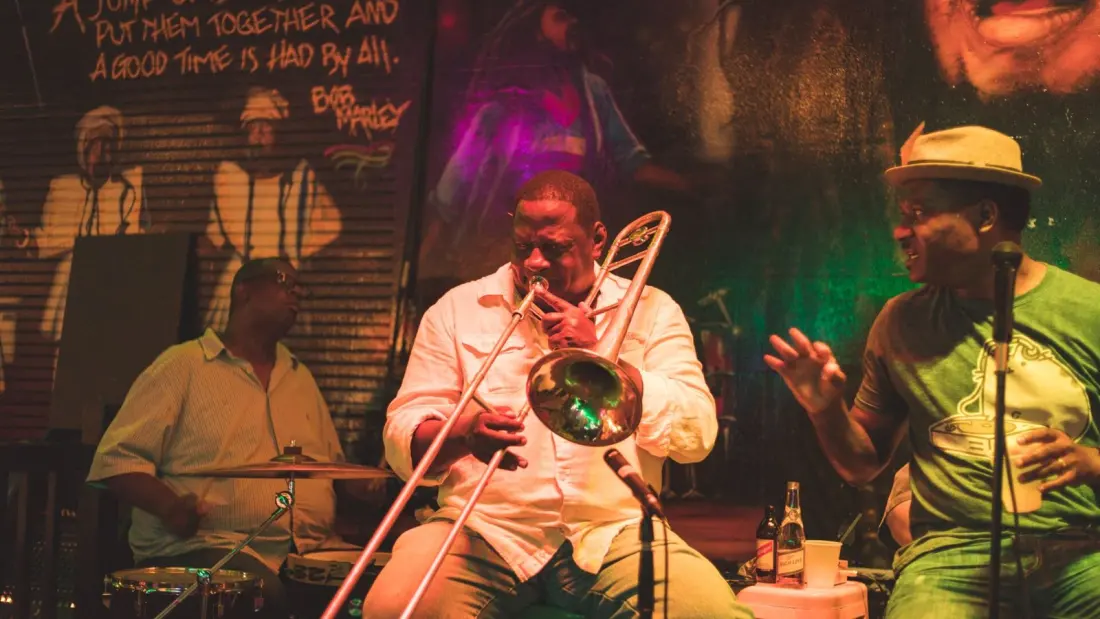
The evening ends in two very different clubs. Fritzel's European Jazz Pub, open since 1969 and the oldest jazz club on Bourbon Street, offers an intimate room where wooden pews put you inches from the band's improvised solos. Then it's on to club 30°/-90° on Frenchmen Street, where a packed crowd sways to everything from funky originals to a Sun Ra cover. It's a pointed contrast to the amplified chaos most visitors associate with Bourbon Street.
For travellers, this is a genuinely useful template for doing New Orleans right: skip the neon stretches, learn the real history at Congo Square and Armstrong Park, then follow live music to Frenchmen Street. Second lines — the joyful street parades trailing a brass band — still run through the culture, and hearing a teenage drummer describe following Armstrong, Jelly Roll Morton and Sidney Bechet north to New York makes the living tradition click in a way no museum plaque can. Book the VIP version for the live accompaniment, or simply steal the itinerary: Armstrong Park, the French Quarter, Fritzel's, then Frenchmen Street after dark.