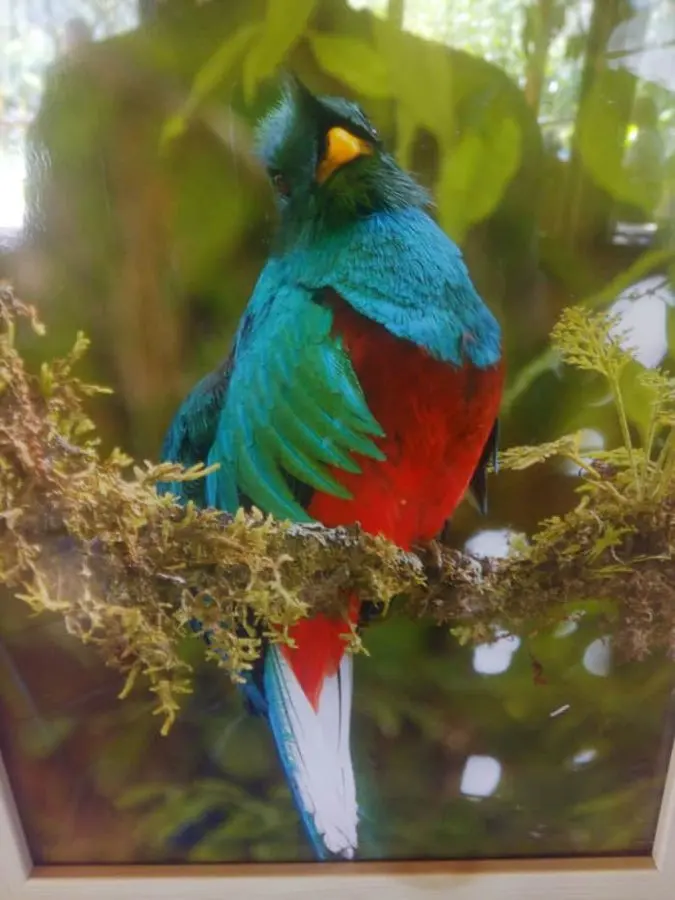
A new study has quietly rewritten the numbers on one of the Americas' most iconic birds. The resplendent quetzal — the iridescent green bird Guatemala puts on its currency — now has a global population estimated at roughly 334,000, less than half of the 770,000 suggested by a 2023 estimate. And the vast majority live in one country: Costa Rica.
The research, published in Bird Conservation International, finds about 193,900 quetzals in Costa Rica's highland forests and another 83,700 in Panama. Add those up and the two southern neighbours hold around 83% of every quetzal left on Earth. The remaining 56,500 or so are scattered across southern Mexico, Guatemala, Honduras, El Salvador and Nicaragua — and those birds are in trouble.
Lead author Edward H. Backus and his co-authors mapped cloud forest between 1,500 and 3,000 metres, the elevation band where quetzals nest, using satellite data from 1990, 2011 and 2021. The picture is stark: nearly a third of the region's breeding forest has vanished in three decades. El Salvador lost 73% of its quetzal habitat, Mexico 65%, Guatemala 53%. Costa Rica lost just 8%, Panama 5%.
The difference comes down to geography and protection. The Cordillera de Talamanca, straddling the Costa Rica–Panama border and including La Amistad International Park, holds a single uninterrupted block of breeding forest covering 442,000 hectares — the next largest, in Guatemala's Sierra de las Minas, is barely an eighth of that. In Costa Rica, almost all mapped quetzal habitat sits inside protected areas.
That split is visible at the subspecies level too. The northern form, from Mexico to Nicaragua, lost 51% of its breeding habitat since 1990; the southern form, found only in Costa Rica and Panama, lost 7%. On that evidence, the authors recommend the IUCN upgrade the species from Near Threatened to Vulnerable, with the northern subspecies potentially listed higher still.
For travellers, the takeaway is simple: Costa Rica is now the place to see a quetzal, and the window depends on forests staying standing. The bird is already a headline draw for the country's birdwatching tourism, a sector that has been growing steadily. Classic spots include the Monteverde cloud forest — where drying conditions linked to vanishing cloud cover are themselves one of the climate pressures the study flags — and the Talamanca highlands around San Gerardo de Dota, where sightings along the Savegre River are famously reliable. The authors call for long-term monitoring in the Talamanca, which makes responsible, guide-led visits there more valuable than ever.
There is genuine uncertainty in the numbers, the authors admit — population figures rest on density assumptions with sparse field counts. But the direction of travel is clear, and it puts Costa Rica in an unusual position: holding both the largest share of the species and the largest stake in its survival.