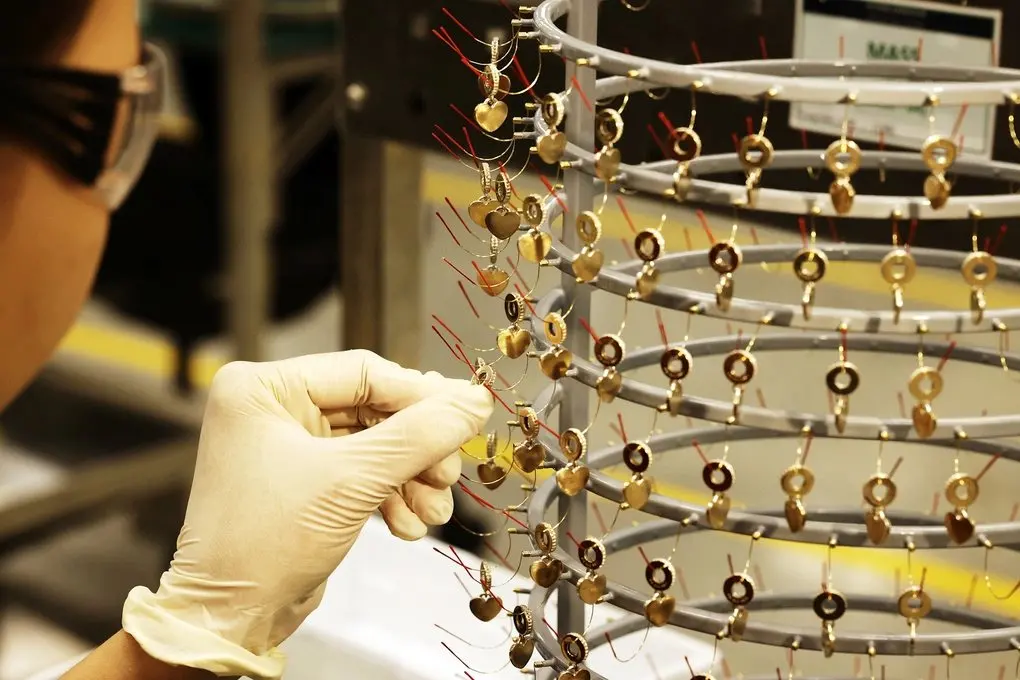
The world's largest finished jewellery factory has started production in Ho Chi Minh City. On 1 October, the first Pandora pieces rolled off the line at a new plant in VSIP III Industrial Park, Binh Co Ward — the Danish brand's first manufacturing base outside Thailand, where it had built its craft over 37 years.
The scale is striking. Pandora has put around $150 million (nearly 4 trillion VND) into a 7.5-hectare complex — about ten football pitches — making it the company's fourth production site globally and its biggest. At full tilt it will employ roughly 7,000 people and turn out up to 60 million pieces a year, lifting Pandora's worldwide capacity by about half. For context, the brand sold 112 million pieces in 2025, so this one factory could account for over half that volume.
Inside, the process remains surprisingly hands-on. Reporters were shown how a design becomes a precision mould, then a wax replica; wax pieces are clustered onto "trees" for metal casting, then clipped off, ground, polished, soldered, set with stones and electroplated before passing quality checks. Machines handle a lot, but artisans still do millimeter-precise work at specialist stations. To get there, Pandora sent Vietnamese specialists to Thailand for training and brought Thai Master Trainers to Vietnam to pass on decades of technique.
The plant is starting with yellow gold-plated collections, where demand is growing fastest, and plans to add platinum plating once workflows settle. Sustainability credentials are baked in: all of Pandora's gold and silver is recycled, the factory runs on 100% renewable electricity and has LEED Gold green building certification. Pandora CEO Berta de Pablos-Barbier said Vietnam was chosen for its business climate, infrastructure and — crucially for jewellery — the manual dexterity of its workforce, calling the opening about "building the next decade" for the brand. Danish ambassador Lina Gandløse Hansen tied it to a wider trend of Danish firms like LEGO investing heavily in Vietnam, though she noted future Danish capital will depend on access to green energy.
For travellers, this is a fresh reason to look beyond Ho Chi Minh City's well-worn highlights. The city is fast becoming a serious manufacturing and design hub, and Vietnam's reputation for skilled craftsmanship is now global news. You can't tour the factory itself, but it slots neatly into a growing interest in Vietnamese maker culture — from silverworking villages to artisan jewellery shops — and gives business travellers and curious visitors alike a new story about what the country makes, not just what it sells.
Story via Vietnam Insider.