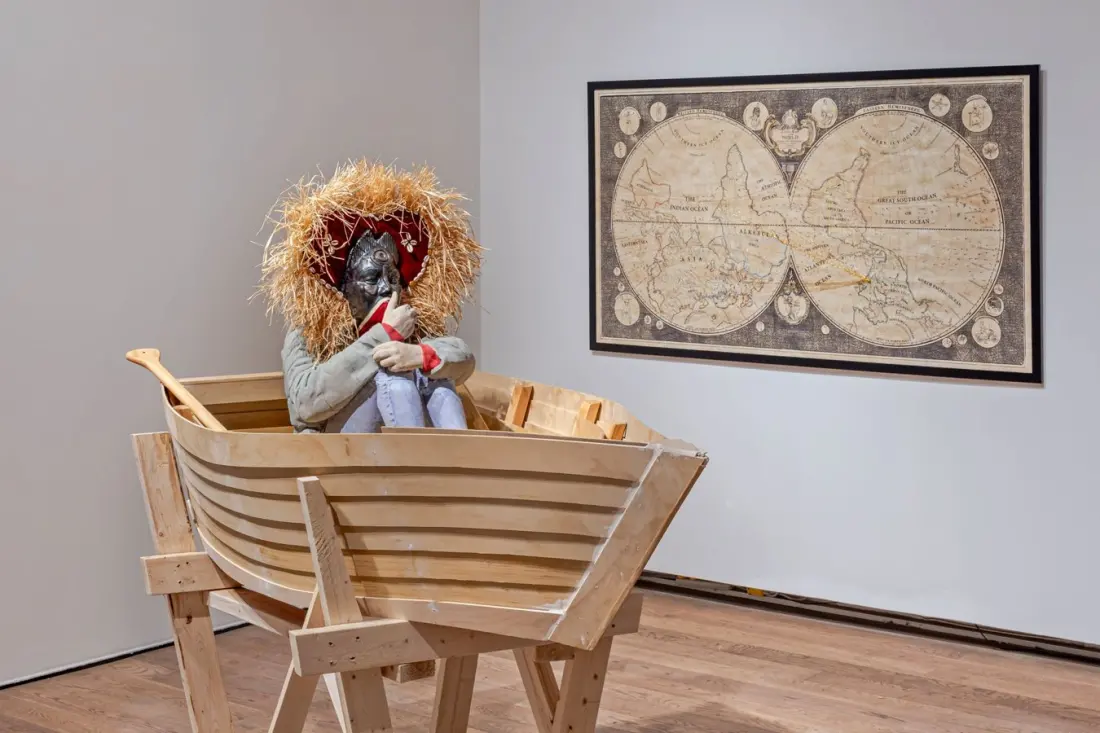
Toronto's Gardiner Museum has launched one of its more unexpected exhibitions in recent memory. After the Island: Caribbean Canadian Ceramics, organised with Black Artists' Networks in Dialogue (BAND), brings together four Canadian artists with Caribbean roots whose work uses clay to explore memory, protection, resistance and belonging — and it runs all the way until April 25, 2027.
This is not a quiet display of vases. Eddy Firmin turns his own body into an interactive video game, letting visitors steer a joystick through stories tied to the African diaspora. He's also behind an installation of ceramic punching bags moulded with his face, fitted with motion sensors so they rotate as you approach — a physical prompt to think about how bodies absorb and push back against violence.
Haitian Canadian artist Manual Mathieu works on your nose instead of your eyes. His centrepiece is a tent of burned canvas, metal and ceramics pitched in the middle of the gallery, part shelter, part exposure, with diffused scents inside designed to unlock memory. PJ Anderson, drawing on her Afro-Jamaican and Red River Métis heritage, treats clay as both armour and container, folding science fiction and futurism into protective sculptures. And Sharon Norwood reimagines a refined dining table using vintage dinnerware, books, textiles, embroidery and ceramic sculpture — a pointed question about whose labour underwrites that kind of elegance.
The show sits alongside the Gardiner's permanent collection, one of the world's dedicated ceramics museums, on Queen's Park right by the Royal Ontario Museum. Regular admission is $18, but if you think you'll come more than once, the annual pass at $30 pays for itself in two visits and gives unlimited entry for a full year.
Why bother? Because this is the kind of exhibition that rewards a slow afternoon in the city — multi-sensory, hands-on in places, and rooted in stories you won't find in the standard museum circuit. It pairs neatly with a museum-heavy day out on Queen's Park or a wander through the adjacent Philosopher's Walk and Yorkville. With a run of more than a year, there's little excuse to miss it, whether you're a Toronto local or plotting a weekend in the city.