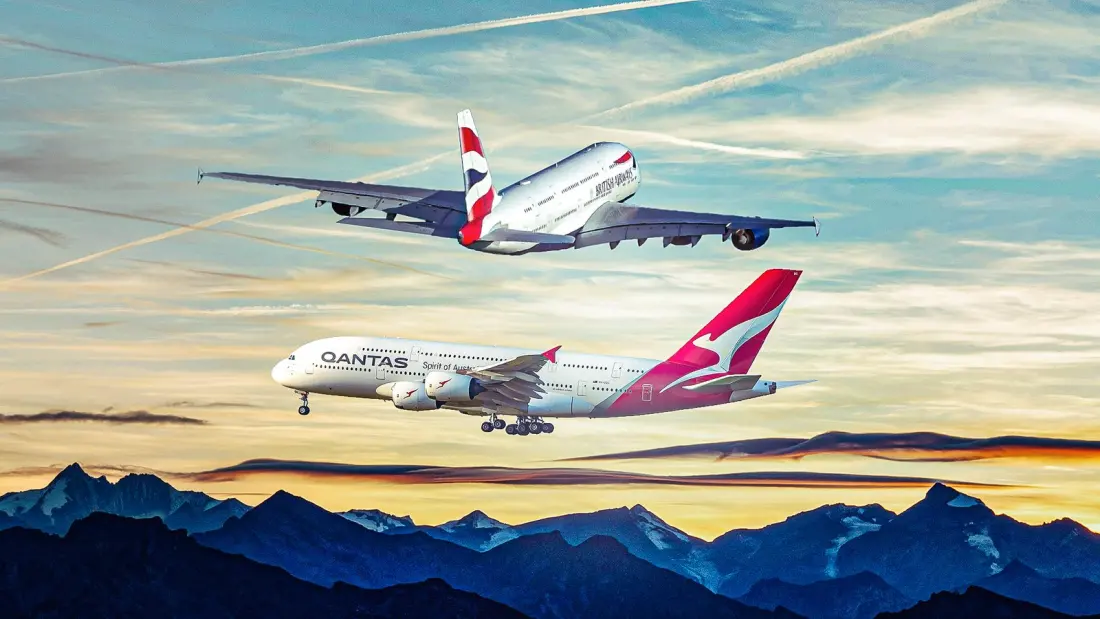
Two of the world's biggest A380 operators have landed on the same idea: even jets headed for early retirement can still earn money if the seats are right. Qantas and British Airways are both reconfiguring their double-deckers, and both are doing it by trimming economy to make room for passengers willing to pay more.
Qantas moved its A380 retirement forward to 2028 — four years earlier than the previous plan — as new Airbus A350s and Boeing 787s arrive to take over its international routes. Ten of the original twelve superjumbos are still flying, averaging around 17 years old, and they won't sit idle in the meantime. Each currently carries 485 seats: 14 first, 70 business, 60 premium economy and 341 standard economy. The airline plans to strip out some of those economy seats and install an "economy extra" option with extra legroom, mirroring what it already offers on narrowbodies, where pitch jumps from about 30 inches to 34. Details remain unconfirmed, but given the A380's existing 32-inch economy pitch, any increase should be noticeable.
British Airways is going much further. As part of a £7 billion (roughly $9.3 billion) overhaul, its 12 A380s are being rebuilt from the frames out — each aircraft needs around 35,000 new parts. Capacity drops from 469 to 421 seats: first shrinks from 14 to 12 seats, a huge 84-seat World Traveller Plus cabin moves to the lower deck (up from 55 upstairs today), economy falls to 215 seats, and the entire upper deck becomes a 110-seat Club Suite business cabin — the largest business cabin in the industry. The first retrofitted jet is expected to enter service this year. Unlike Qantas, BA hasn't set a retirement date for its A380s, signalling the investment is meant to pay off for years.
The motivation is the same on both sides of the world: premium demand keeps climbing. IATA figures show business and first-class passengers grew 4.5% year-on-year to 109.7 million in 2025, after an 11.8% jump in 2024. Qantas' own results back this up — its international premium cabin revenue rose 15%, well ahead of the segment's 8% overall growth to AU$9.9 billion.
For travellers, the practical takeaway is straightforward. If you fly Qantas long-haul on A380 routes in the next few years, expect a new mid-tier economy option worth watching if extra legroom matters to you. On British Airways, the refurbished A380s will be unusually generous planes for anyone flying premium economy or business — nearly half the cabin will sit above standard economy once the project is done. Neither airline is announcing these changes out of nostalgia for the superjumbo; it's a calculated move to monetise seats on aircraft that still have useful life left. But the net effect works in passengers' favour: more space, more choice, and on BA's A380s, one of the most business-class-heavy configurations in the sky.