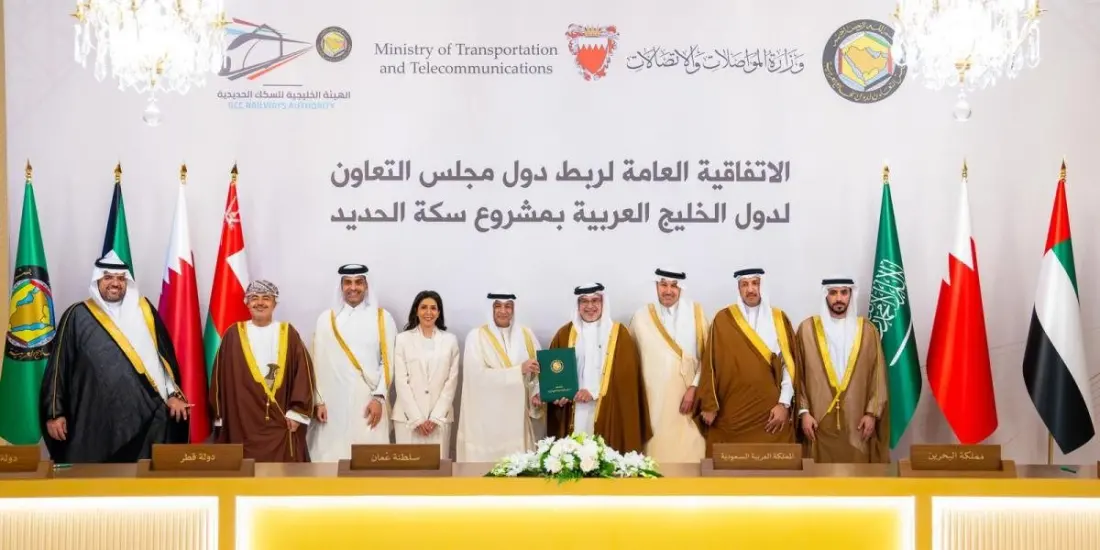
Qatar has put pen to paper on a deal that could eventually let you travel by rail across the entire Gulf. The General Agreement to Connect the Countries of the GCC Through the Railway Project was signed in Manama, Bahrain, on Sunday 8 November 2026, during the 30th Meeting of GCC Ministers of Transport. It commits all six Gulf Cooperation Council states — Qatar, Saudi Arabia, the UAE, Bahrain, Kuwait and Oman — to building an integrated, interoperable rail network for passengers and freight.
The idea is far from new. The GCC Supreme Council first approved a connected railway plan back in 2009, and in December 2021 it created a GCC Railways Authority to coordinate the work and make sure each country's national network plugs into the others. Sunday's agreement now gives that coordination a formal legal framework, which is the piece officials have long said was missing.
The signing was attended by Bahrain's Crown Prince and Prime Minister, Prince Salman bin Hamad Al Khalifa, alongside GCC transport ministers and Secretary General Jasem Mohamed Albudaiwi. Albudaiwi called the deal a significant step toward running the railway as a single regional system, while Qatar's Transport Minister, Sheikh Mohammed bin Abdulla bin Mohammed Al Thani, framed it as the foundation for a Gulf-wide transport ecosystem.
So what would it actually mean for travellers? Today, hopping between Doha, Dubai, Riyadh or Manama means flights, long drives, or — since Qatar and Saudi Arabia reopened their land border — a car journey across the Salwa crossing. A finished GCC railway would change that, making multi-country Gulf trips far simpler. Officials say the network should speed up the movement of people and goods, improve logistics, open up trade and tourism opportunities, and position the region as a bigger transport and logistics hub. Qatar also reaffirmed it will keep backing joint GCC infrastructure projects under the Amir's directives.
Keep expectations in check on timing, though. Rail mega-projects in the Gulf move slowly, and the agreement is a framework rather than a construction start date. Still, each signing like this moves the region closer to a future where a holiday could stretch from Doha's museums to Riyadh's desert edges to Dubai's beaches without setting foot in an airport.
For now, the practical takeaway is this: if you're planning a Gulf trip in the next few years, you'll still be flying or driving between countries — Qatar Airways and its regional rivals remain the workhorses, and Saudi Arabia's own new rail lines are the best way to see that country overland. But if you've been waiting for a genuinely connected Gulf, this agreement is the clearest signal yet that it's on the roadmap, not just in speeches.
Reported first by Doha News.