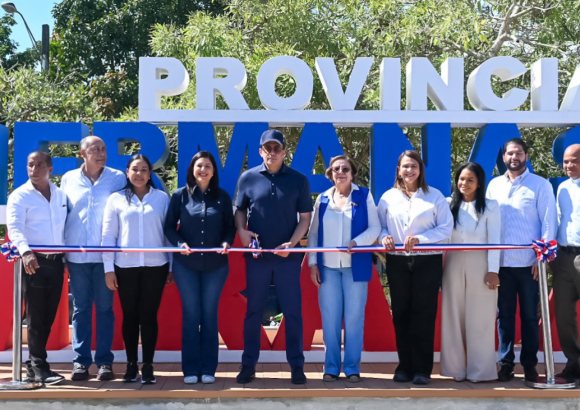
A once-mundane traffic island at the entrance to Salcedo, in the Dominican Republic's Hermanas Mirabal province, has been transformed into a proper public space. Tourism Minister David Collado handed over the finished project, a RD$10.2 million renovation covering 780 square metres along Manolo Tavárez Justo Road, right where most visitors enter the municipality.
It's part of a wider push by the Ministry of Tourism to reclaim and upgrade public spaces across the country — the idea being that well-designed streets and squares do more than look nice; they signal to travellers that a town is worth stopping in.
What you actually get at the new island is fairly comprehensive: an open esplanade, signage branded with the city's identity, street furniture, landscaped planting, new lighting, stairs, ramps, pedestrian crossings, trash receptacles, and reworked drainage, curbs and road signs to sort out both foot and vehicle flow. In other words, it's built to be used, not just photographed.
Collado used the handover to flag the tourism potential of Hermanas Mirabal, a largely inland, agricultural province that sits well off the Punta Cana–Puerto Plata beach circuit. Salcedo (officially Villa Juan Sánchez, though everyone says Salcedo) is best known for the Mirabal sisters, the three siblings murdered under the Trujillo dictatorship in 1960 — the province itself is named after them, and their former home in Salcedo is now a museum. The town also anchors a region of cocoa and other farm country that the ministry has been trying to bring into the Dominican tourism conversation.
Why should a traveller care? Because small infrastructure projects like this are often the first sign of a place investing in visitors. If you're road-tripping through the country's northern interior — maybe combining Salcedo with Moca, the Mirabal sisters museum, or the hilltowns towards Jarabacoa — a welcoming, walkable entrance to town makes a detour far more pleasant. It's also a nudge that the Dominican Republic is working to spread tourism beyond the all-inclusive coastal strips and into places most foreign visitors never see.
For now, expect more announcements like this: Collado has made clear the ministry intends to keep recovering public spaces for locals and travellers alike.