
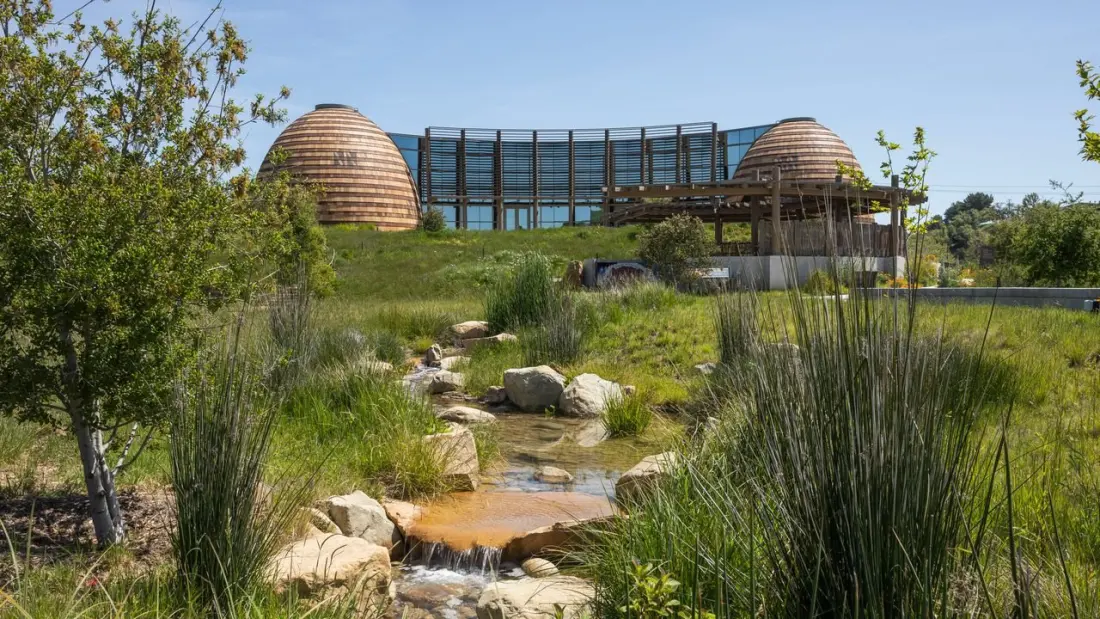
After two decades in the making, the Santa Ynez Chumash Museum and Cultural Center opened on May 15, 2025, and it's quickly earning its place alongside the wineries and beaches of California's Central Coast. Condé Nast Traveler named it one of its Bright Ideas in Travel 2025, and a visit makes clear why.
The 14,000-square-foot building, designed by Native American architect Johnpaul Jones, takes the shape of a traditional 'Ap — the dome home the Chumash once built from willow and tule reeds — reimagined in steel and stone. Even the door handles are cast like clapper sticks, a traditional percussion instrument. The building faces Point Conception, the cliff-lined headland that the tribe calls the Western Gates, a place of deep spiritual significance. It's a museum where the lines between indoors and outdoors blur: birdsong plays under a curved ceiling, and standing in exactly the right spot on the inlaid stone floor sends your own voice echoing back at you.
Inside, exhibits walk through Chumash cosmology — Upper, Middle, and Lower worlds — with stone tools, abalone regalia, and a swordfish headdress, many pieces made by tribal members working today. One of the most moving stories belongs to Maria Solares, one of the last fluent speakers of Sʰamala, whose 1914-15 recordings with linguist John Peabody Harrington (100,000+ pages of notes) kept the language alive. Her descendants volunteer at the museum today. Another gallery honours a California condor — the last wild female captured in 1986, when just 27 condors remained — whose breeding-program offspring now fly free again.
Don't skip the outdoor Culture Park. Native plantings border greywater-fed pools, and the Tomol House shelters a 950-pound plank canoe that still goes to sea. This tomol has made 'the crossing' multiple times — 26 miles of open Pacific from Ventura to the Channel Islands, paddled on knees over 10 to 13 hours. It's a reminder that this culture is living, not archived.
The museum is part of a bigger story: in 2024, more than 4,500 square miles of sea and coast here were designated the Chumash Heritage National Marine Sanctuary, the first Indigenous-led marine sanctuary in the US. For travellers road-tripping between Santa Barbara and Paso Robles, this is the most meaningful stop on the route — a chance to engage with the people who have lived this coastline for over 13,000 years.
Practicalities: the museum sits in Santa Ynez and is open Thursday through Sunday, 10 a.m. to 5 p.m. Pair it with the nearby Santa Ynez Valley wine country or a drive up to Point Conception for the full picture.