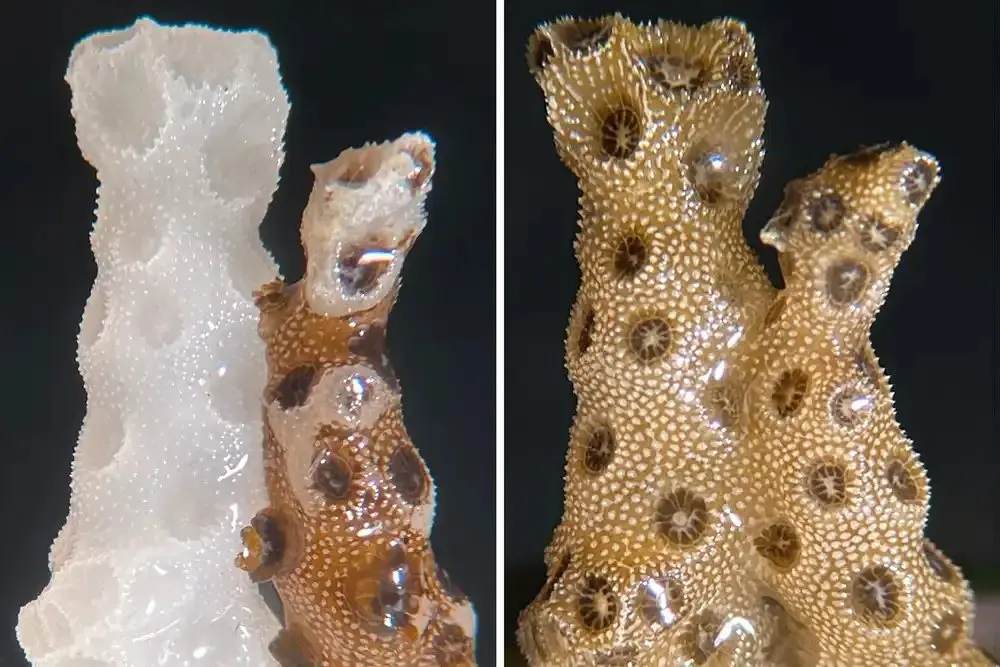
A bleached coral is not necessarily a dead coral — and a Stanford University team has found that touching a healthy neighbour can bring one back from the brink. The research, published in Science Advances and led by PhD student Daniel Collins at Stanford's Hopkins Marine Station, began with a happy accident in 2025: a healthy coral fragment fell against a bleached one in a lab tank, and the pale fragment started regaining colour exactly where the two touched.
The team ran a controlled experiment with ten pairs of fragments from a single colony of Pocillopora damicornis, the branching coral known as cauliflower or lace coral. Five pairs were placed in direct contact; five were kept a few millimetres apart. The result was striking. Every bleached fragment in contact with a healthy one recovered within seven to eight weeks. Every isolated fragment died.
What happened under the microscope explains why. The touching fragments fused their tissues, creating microscopic channels through which zooxanthellae — the symbiotic algae that live inside coral, produce most of its energy through photosynthesis and give it colour — could pass from healthy coral to bleached coral. Once transferred, the algae multiplied at roughly ten times the rate seen in natural recovery, doubling in number every four days. Better still, the connection didn't need to be permanent: a few days of contact delivered enough algae for the bleached coral to keep recovering on its own.
There's a catch, and it's a big one. The tissue fusion only worked between genetically identical fragments from the same colony. When fragments from different colonies — even of the same species — were joined, they rejected each other, pushing out stinging filaments to attack the foreign tissue. In some cases the healthy coral simply grew over its dying neighbour. That genetic specificity makes direct contact useless for restoring large swathes of damaged reef, where no two corals are clones of each other.
But the mechanism itself is the prize. If researchers can work out how to collect and cultivate beneficial algae from healthy corals and introduce them to bleached colonies without physical contact, the technique could become a genuine restoration tool. Co-author Professor Fiorenza Micheli, co-director of Stanford's Center for Ocean Solutions, says the goal is to keep damaged corals alive long enough for slower natural recovery processes — growth, reproduction and new colony recruitment — to take over after heatwaves.
For divers and snorkellers, the research reframes what a bleached reef means. Recovery after a marine heatwave can take months or years, leaving corals exposed to disease, and bleached colonies are often written off. This study suggests they may be salvageable. It won't change your next trip to the reef, but it hints at a future where dive destinations damaged by warming seas have a better shot at bouncing back — and where the white skeletons you swim past today might not be the final word.