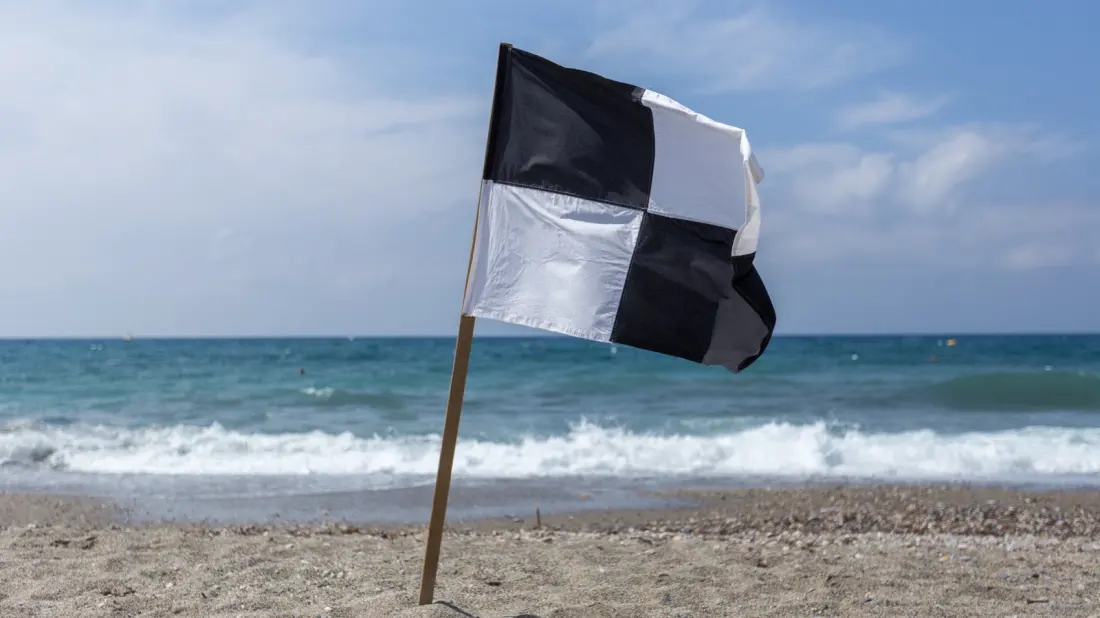
That checkered flag on the beach isn't signalling the end of a race — it's telling you to keep out of the water. According to the flag systems used by the International Life Saving Federation and the United States Lifesaving Association, a black and white quartered flag marks a designated surf zone: an area reserved for surfboards and non-powered craft like boogie boards, paddleboards and kayaks.
The design is easy to tell apart from a racetrack finish flag. Instead of dozens of small squares, the lifeguard version has just four large quadrants — black in the top left and bottom right, white in the top right and bottom left. You'll usually see them flown in pairs, with the stretch of water between the two flags set aside for board riders.
For swimmers, the message is simple: treat it like a red flag and stay out — at least in that section. The reasoning comes down to physics. A surfboard is a hard object moving at speed, and even a skilled rider can't always dodge someone in the water, especially once they've built up momentum. Swimmers are also surprisingly hard to spot among rolling waves, leaving surfers little time to react. Whether you're at Haleiwa on Oahu's North Shore — often called the surfing capital of the world — or a quiet cove somewhere else, mixing the two is a recipe for collisions.
There's a flip side, too. Many beaches mark swim-only zones where surfers aren't allowed, for exactly the same safety logic. And often the separation happens naturally: the big waves and rip currents that make for good surfing make swimming genuinely hazardous, while the flat, calm water swimmers love holds little appeal for board riders.
Even when no flags are flying, a little observation goes a long way. If a stretch of beach is clearly being used by surfers, swim somewhere else — the conditions that drew them there probably aren't great for you anyway. And if you're the one holding the board, resist the temptation to ride waves through a crowded swim area, designated or not. Check the flags, watch the water for a few minutes, then get in. It costs nothing and could spare you a nasty knock to the head.