A puma found badly hurt beside Route 32 in Guápiles — the highway that links San José to Costa Rica's Caribbean coast — is fighting its way back after two rounds of surgery at the National University's Small Species and Wildlife Hospital (Hems-UNA) in Heredia.
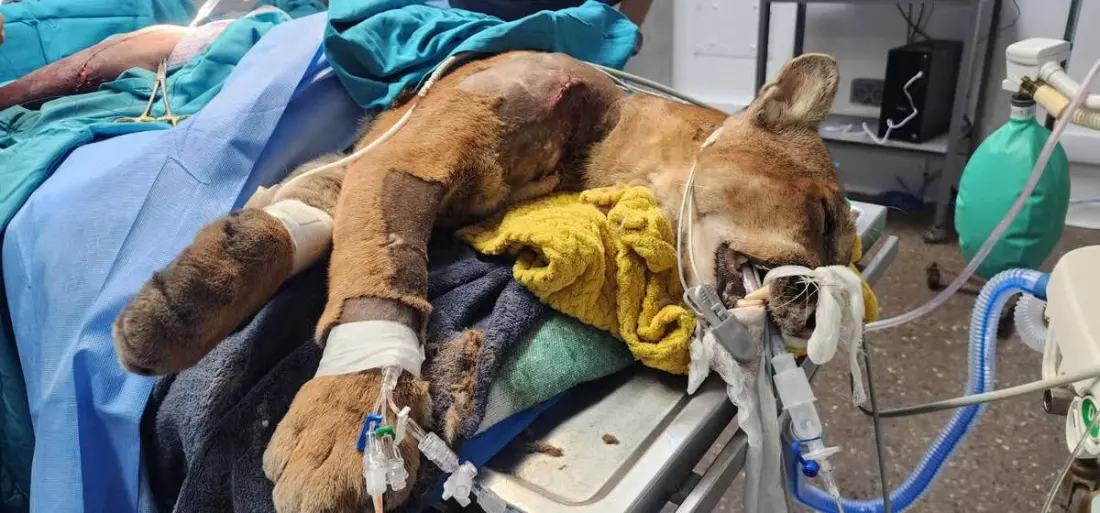
The cat was spotted on Wednesday morning and sedated at the scene by officials from the Tortuguero Conservation Area, with firefighters and police helping out. It then made the trip to the university hospital in critical condition, having lost a lot of blood and suffering from anemia. Torn abdominal tissue was repaired, and vets had to stabilize the animal before any surgery could happen.
Hospital director Mauricio Jiménez described the damage in blunt terms. The first operation dealt with an open fracture, fixed with two plates. The femur was worse: splintered in several places, with part of the bone simply gone — fragments, he explained, are often forced out of the body in an impact that violent. A second operation the following day stabilized the leg. Beyond the fractures, the puma has serious inflammation around its spinal cord and is now receiving physical therapy and wound care alongside the medication. By Friday it was still in pain and unable to stand, but had started eating small amounts of food — a small but real sign of progress.
The plan, if all goes well, is to release the puma back into the wild. That won't happen quickly: it will need follow-up care after leaving the hospital and is expected to move to a wildlife rehabilitation center for the next stage. No timeline has been given.
There's a message here for anyone driving in Costa Rica. Elena Vargas, director of the Tortuguero Conservation Area, asked drivers to ease off the accelerator and stay alert on stretches of road bordered by forest, where animals cross frequently. Route 32 is the main artery to the Caribbean coast —Limón, Tortuguero, and the canals — so plenty of travellers use it, often at speed. Injured or at-risk wildlife can be reported by calling 1192 or 911.
Why should a traveller care? Because this story is really about the roads you'll drive. Costa Rica markets itself on biodiversity, and that biodiversity is on and beside its highways. Slowing down in forested sections costs you a few minutes and could save an animal — or avoid a serious accident of your own. And if you'd like to support the system that made this rescue possible, the network of conservation areas and university wildlife hospitals is exactly where rescue fees, donations, and responsible eco-tourism dollars flow. A puma's road to recovery starts, inconveniently but importantly, with drivers paying attention.