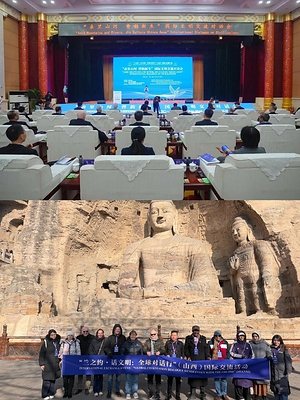
Shanxi Province just hosted a six-day international cultural exchange running from 20 to 25 November, sweeping more than 50 delegates through four cities — Datong, Shuozhou, Taiyuan and Jinzhong. The programme, called 'Global Civilization Dialogue: Rendezvous with the Orchid', brought together winners and judges of China's Orchid Award alongside scholars, media creators and journalists. For travellers, it's a handy ready-made route through one of China's most historically rich yet under-visited provinces.
The itinerary reads like a greatest-hits list. It opened at the Yungang Grottoes near Datong, a UNESCO World Heritage Site where tens of thousands of Buddhist figures were carved into sandstone cliffs from the fifth century under the Northern Wei dynasty — a fusion of Chinese, Indian and Central Asian artistic styles. Next stop was Shuozhou's Yingxian County, home to the Yingxian Wooden Pagoda, a towering 11th-century structure built without a single nail, held together entirely by interlocking mortise-and-tenon joints.
In the provincial capital Taiyuan, delegates toured the Shanxi Museum's 'Soul of Jin' exhibition and the ancient halls of Jinci Temple, one of the region's oldest temple complexes. Jinzhong brought the merchant era to life at the sprawling Wang Family Compound — a fortress-like mansion of a Qing dynasty banking family — and the walled Ancient City of Pingyao, a remarkably intact Ming-era town that was once the financial centre of imperial China.
The trip wasn't purely about the past. Delegates travelled the Fenhe River Ecological Corridor, where a badly polluted waterway has been restored into a green spine running through the city, and toured Geely Automobile's plant in Jinzhong, watching modern electric-vehicle manufacturing at work in a region historically dependent on coal. Round-table discussions on 'Jin culture' and Shanxi's merchant tradition of trust and trade rounded things out.
Why should this matter to you? Shanxi remains one of China's best-value cultural destinations, and these four cities sit within a few hours of each other, making an easy overland loop. You can pair fifth-century cave art with a stroll on Pingyao's city walls and finish with street food in Taiyuan — without the crowds of Xi'an or Beijing. And as the province pushes to rebrand itself beyond coal, expect improved infrastructure, signage and experiences in the coming years.
The event was guided by the China International Communications Group (CICG), whose Orchid Award honours foreign individuals and organisations for contributions to cultural exchange with China, with local municipal publicity departments co-organising. Whatever the diplomatic framing, the practical takeaway for travellers is simple: Shanxi's headline sights are now packaged into a logical four-city route that works just as well for an independent trip.