Singapore has quietly become the first city in the world to deploy Wolbachia mosquito suppression across a dense, high-rise tropical environment, and the numbers are striking. In 2025 the country recorded a seven-year low in dengue, with roughly 4,000 cases. In areas where Wolbachia-carrying males are released, Aedes aegypti populations have dropped by up to 90%, and dengue risk has fallen by more than 70%.
The science is simple but clever. Wolbachia is a naturally occurring bacterium found in most insect species — no genetic modification involved. Since 2016, the National Environment Agency (NEA) has bred male Aedes aegypti mosquitoes carrying it and released them into neighbourhoods. When these males mate with wild females, the eggs never hatch. And since male mosquitoes don't bite, the whole exercise is harmless to residents and travellers alike.
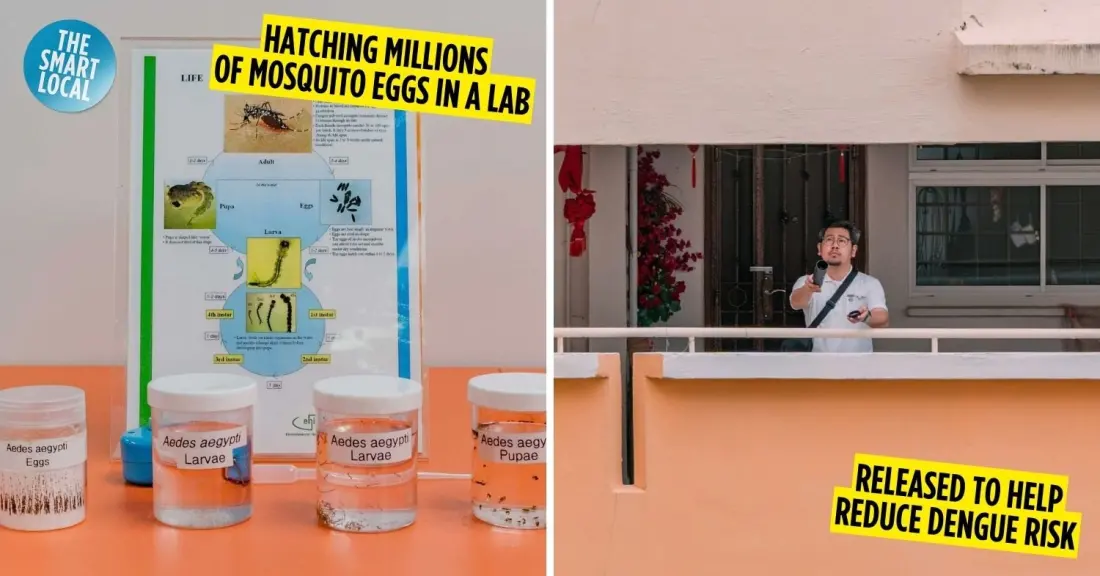
A look inside NEA's production facility in Ang Mo Kio reveals the scale of the operation. Millions of eggs sit on standby, hatched into larvae that are counted by machines processing 25,000 per tray in five minutes — a job that once took a human over three hours for 4,000. The larvae are reared in climate-controlled rooms held at 28°C and 80% humidity, fed on premium fish food via automatic dispensers. At the pupal stage, sex sorting happens through size-based sieves, backed by a Pupae Size Scanner and a low-dose X-ray pass that sterilises any females that slip through. Before release, the males even face a flight test to prove they can out-compete wild rivals for mates.
Up to twice a week, NEA officers release batches of these males from small canister launchers at ground level and on different floors of residential blocks. Gravitraps — black canisters with sticky linings that lure egg-laying females — then track whether populations are falling. A study published in the New England Journal of Medicine found 71–72% protective efficacy against dengue in release zones, and even people in adjacent areas are 45% less likely to catch dengue.
This month the programme expanded to Ang Mo Kio, pushing coverage past 840,000 households — more than half of Singapore — as it marks its tenth anniversary. A public carnival follows on 31 October 2026 at Our Tampines Hub, with exhibits, kids' activities and a chance to handle the male mosquitoes yourself.
Why should travellers care? Dengue is a real risk in tropical Asia, and Singapore's model shows why the usual advice matters. The programme only targets Aedes aegypti, so other biting mosquitoes still breed in stagnant water. The NEA's B-L-O-C-K routine — breaking up hardened soil, lifting flowerpot plates, overturning pails, changing vase water and clearing gutters — is worth practising anywhere in the region. If you're in Singapore and spot officers with launcher canisters, they're not there to add to your bites; they're sending in reinforcements.