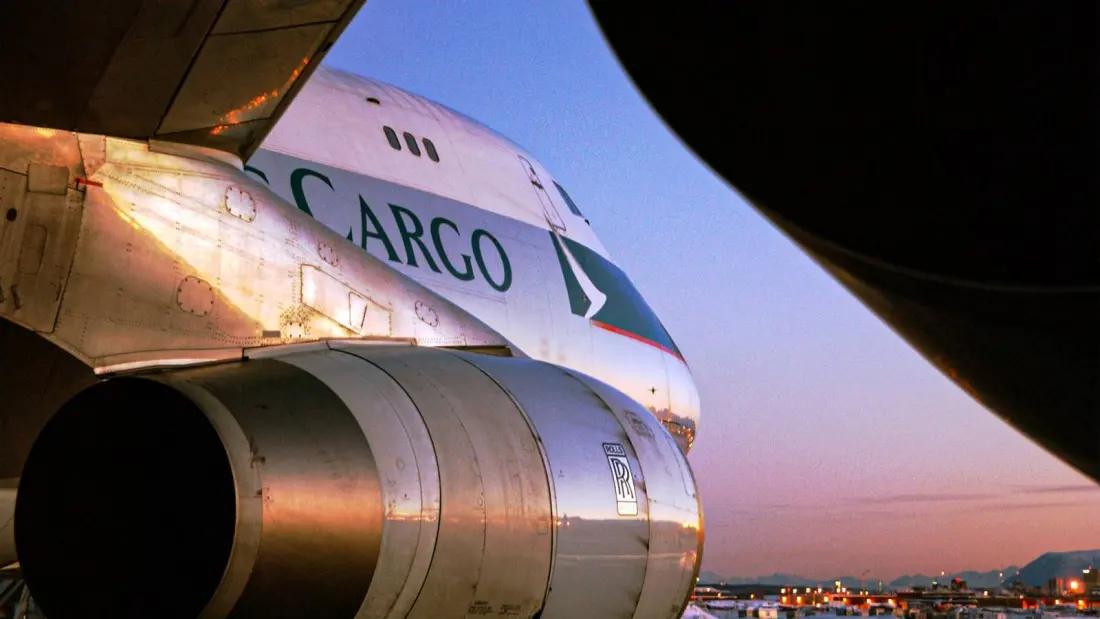
Every non-stop flight you take across an ocean traces back to a series of enormous engineering gambles made by Rolls-Royce, the British engine maker. A recent look at the company's aviation history traces four engine generations that turned intercontinental flying from a fuel-guzzling luxury into an everyday, economically viable reality.
It starts with the Conway, which entered airline service in 1960 as the world's first production turbofan. Engineer Sir Stanley Hooker realised that accelerating a larger volume of air more gently — routing about 30% of intake air around the hot engine core — burned less fuel and made less noise than the pure turbojets of the day. The result: Conway-powered Boeing 707-420s and Douglas DC-8-40s could cross the Atlantic non-stop with full passenger loads, no refuelling stop needed. On the Vickers Super VC10, four Conways pushed out 21,000 lbf each, and the bypass principle became the template for essentially every airliner engine since.
The next leap nearly destroyed the company. For the Lockheed L-1011 TriStar, Rolls-Royce bet on the RB211, a radical three-shaft design that let each compressor run at its own optimal speed — shorter, lighter, more efficient. The gamble on carbon-fibre fan blades backfired when they shattered in bird-strike tests, and the switch back to titanium sent costs spiralling. By February 1971 Rolls-Royce was bankrupt and nationalised under Edward Heath's government. But the RB211-22B, entering service in 1972 with 42,000 lbf of thrust, proved an aerodynamic masterpiece, and the three-shaft philosophy became the company's signature.
That philosophy scaled. The Trent 700, launched for the Airbus A330 in the early 1990s, carried a 2.47-metre fan and a 5.0:1 bypass ratio, producing up to 72,000 lbf and winning over 60% of the A330 engine market. Its descendants powered the Boeing 777, A380 and 787. Then came the Trent XWB, the exclusive engine for the Airbus A350 and the fastest-selling widebody engine ever. With a three-metre fan, a 50:1 overall pressure ratio and turbine blades running hotter than their own melting point thanks to ceramic coatings, it cut fuel burn by 15% over earlier Trents and lets twinjets fly more than 8,000 nautical miles non-stop — effectively ending the era of four-engine long-haul aircraft for most airlines.
Why should a traveller care? Because cheaper, quieter, longer-range flights are the direct product of this lineage. The bypass ratio climb from the Conway's 0.3:1 to the Trent XWB's 9.6:1 is the reason a London–Sydney-style itinerary is a single flight rather than a multi-stop odyssey, and why fares per mile keep falling. Next up is the UltraFan, a geared design targeting a 14:1 bypass ratio, up to 25% better efficiency than first-generation Trents, and full compatibility with 100% sustainable aviation fuel — which could eventually mean a lower-carbon long-haul ticket.
Story via Simple Flying.