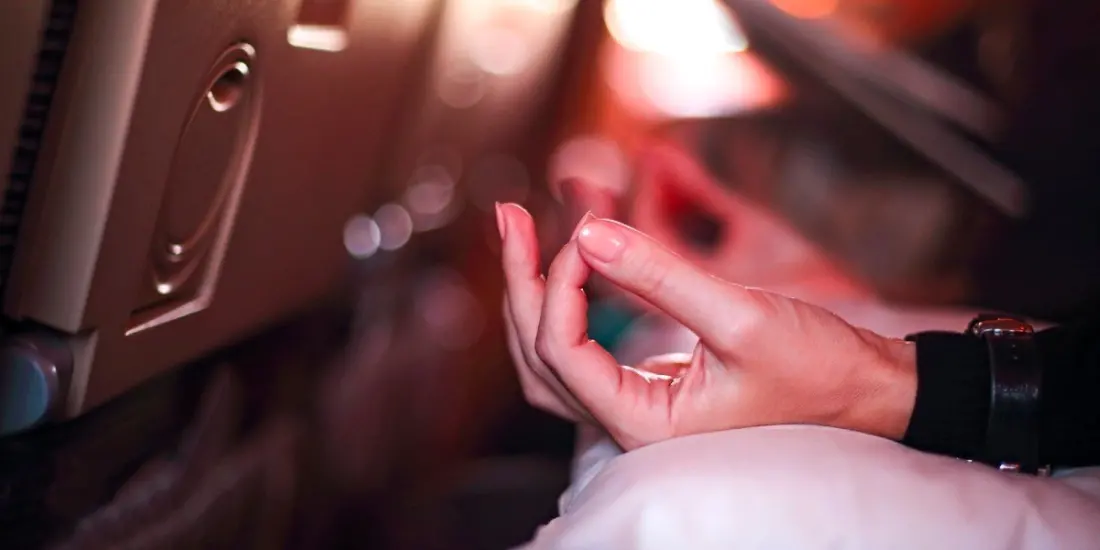
Long-haul flights are rough on the body: cramped seats, dry cabin air, and hours without real movement leave most of us stiff, foggy, and grumpy by landing. Catrina Reeder, who directs new studio openings at CorePower Yoga and has taught for over a decade, says you don't need to crowd the galley or bug your seatmate to feel human mid-flight. Her fix is a six-move sequence you can do entirely in your seat.
It starts with breath, not movement. Seated breathing — one hand on your heart, one on your belly, eyes closed — slows the heart rate and switches on the parasympathetic nervous system, the body's rest-and-digest mode. She suggests three to five slow breaths, feeling the ribcage expand in all directions. It's the quickest reset available at 35,000 feet.
From there, the sequence moves through the spine's full range of motion. Seated cat-cow (arch the back on an inhale, round it on an exhale, five to eight rounds) undoes the slouched posture that flights encourage. Seated side stretches follow, reaching one arm overhead and leaning to the opposite side, waking up the core and lengthening the torso. Then come seated twists, done gently from the bottom up — hips, then shoulders, then neck. Reeder's favourite cue: imagine picking an orange from a tall tree on the inhale and planting it in a basket behind your seat on the exhale. Repeat on both sides.
The last two moves target the hips and the whole back of the body. Hip stretches restore blood flow to muscle groups that get compressed from sitting — options include a seated figure-four (ankle crossed over thigh, gently leaning forward) or an L-shaped leg position with an elbow propped on the out-turned knee. The sequence closes with a seated forward fold: chin tucked, spine rounded, arms dangling toward the floor between wide legs. Because the head drops below the heart, it acts as a mild inversion and an energiser — though anyone prone to vertigo or migraines should skip it, and everyone should rise slowly.
Why it matters: the sequence takes maybe ten minutes, needs no equipment, and won't disturb the crew or your neighbour. It hits the areas that suffer most in flight — spine, hips, shoulders — and the breathing component can genuinely take the edge off flight anxiety or jet-lag fog. Pair it with regular walks up the aisle and you'll arrive noticeably looser. It's useful for anyone on a flight longer than a couple of hours, and especially for economy travellers on overnight routes who land stiff and want to hit the ground moving.