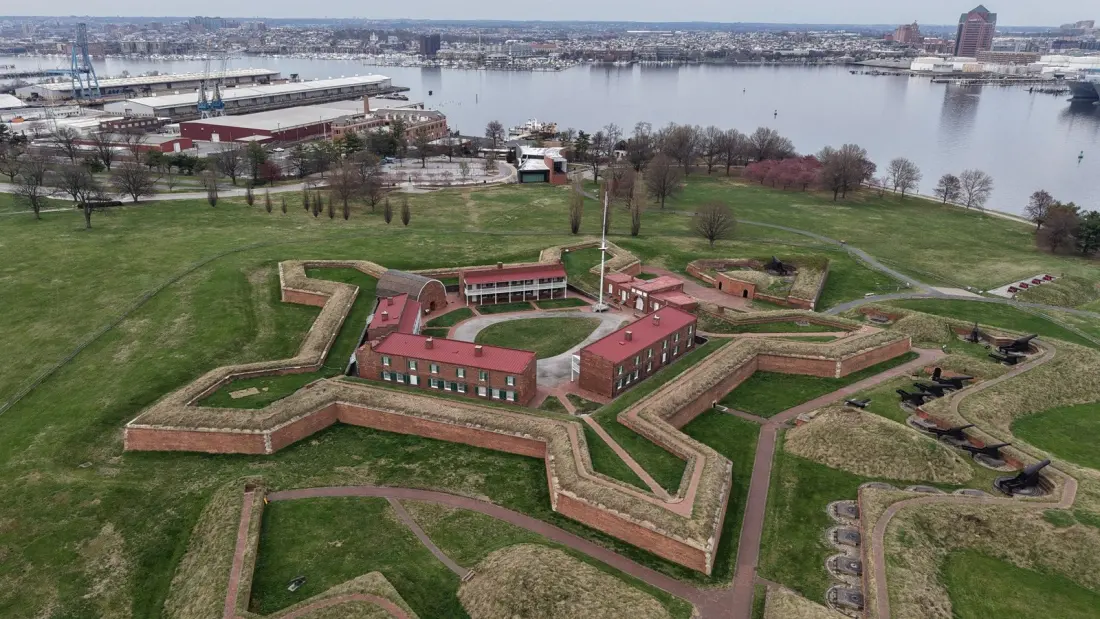
Two miles from Baltimore's Inner Harbor sits a fort shaped like a five-pointed star, and it's the reason Americans sing about rockets' red glare. Fort McHenry, on the Locust Point peninsula between the harbour and the Patapsco River, was the target of a 25-hour British naval bombardment in September 1814, during the War of 1812. Francis Scott Key, a Maryland lawyer watching from a truce ship offshore, saw the American flag still flying at dawn on September 14 and wrote a poem about it at the Indian Queen Hotel. Set to the tune of an English drinking song, it became 'The Star-Spangled Banner'.
Today the fort is a national monument and the only National Park Service site designated a historic shrine. A $15 standard pass gets you into the preserved brick buildings — a guardhouse, a gunpowder magazine and four barracks — each fitted with exhibits on garrison life. Daily flag-changing ceremonies at 10 a.m. and 4 p.m. let visitors help handle the flag, often a 15-star, 15-stripe version representing the Union as it stood in 1814. On good mornings, the biggest flag in the collection goes up: a 30-by-42-foot replica of the original, deliberately made huge so the British could see it from a distance, as commander Major George Armistead intended. In summer, living historians add fife, drum and weapons demonstrations.
The story doesn't stop at 1814. During the Civil War the fort's cannons pointed both outward and inward, holding Confederate prisoners — including many captured at Gettysburg — plus secessionist political detainees, which earned it the nickname 'The American Bastille'. Rodman cannons from that era remain on the outer battery, and a separate Civil War powder magazine sits along the sea wall trail.
That trail is a draw in its own right: a paved, one-mile loop along the water with benches and cherry blossom groves that peak in late March or early April. Walk it or cycle it for free, with views across the water to the site of the Francis Scott Key Bridge, which collapsed when a container ship struck it in 2024 and is scheduled to be rebuilt by 2030.
Getting there is easy — Baltimore's free Charm City Circulator bus runs along the Banner Route straight to the fort. Serious anthem enthusiasts can go deeper: the Maryland Center for History and Culture displays Key's handwritten manuscript, and the actual flag he saw that morning hangs in the Smithsonian's National Museum of American History in Washington, D.C., about 45 minutes away by train.
For anyone with even a passing interest in American history, this is one of those rare sights where the backstory genuinely matches the place. You're standing on ramparts built as part of the country's first seacoast defence system, renamed for James McHenry, a Constitution signer who served as secretary of war under both Washington and Adams. Couple it with the Inner Harbor, and it makes a solid day — or a full Baltimore weekend with a D.C. add-on.