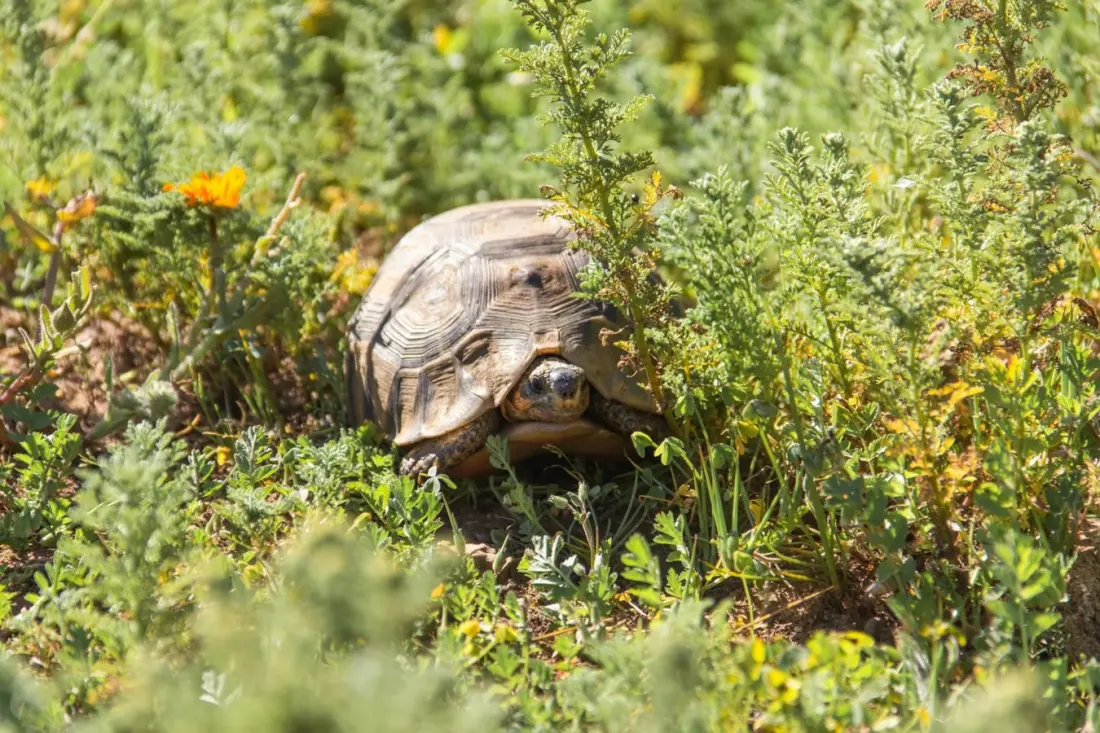
South Africa holds a record most travellers never hear about: it has the richest tortoise diversity of any country on Earth, with 13 recognised species across the southern African region. From the leopard tortoise grazing on savannah grasses to tiny, rock-dwelling species hidden in the fynbos, these reptiles have quietly mastered some of the country's toughest environments.
Their survival tricks are worth knowing before you go, because they shape when and where you'll actually see one. Tortoises are ectothermic, so they rely on outside heat and often shelter under vegetation, rocks or in burrows during the hottest hours. After rainfall is prime spotting time. The angulate tortoise, common in the Western and Eastern Cape, has relatively impermeable skin to limit water loss in dry conditions, while the leopard tortoise — the country's largest — shifts its diet with the seasons and even spreads seeds through its droppings, helping plants regenerate.
But these ancient survivors are under real pressure. The most striking case is the geometric tortoise, a Western Cape endemic with bold yellow shell patterns, now restricted to fragments of renosterveld vegetation. It's Critically Endangered, and CapeNature estimates fewer than 3,000 remain in the wild, mostly due to agricultural expansion. Elsewhere, road deaths, poorly designed electric fencing, illegal collection for the pet trade and a shifting climate all take a toll — a problem for animals that reproduce slowly and can take decades to recover from decline.
For travellers, several protected areas offer good odds of a sighting. West Coast National Park's coastal fynbos is home to angulate and parrot-beaked tortoises. Karoo National Park is a favourite with reptile fans — SANParks even suggests checking around the rest camp. The rocky Cederberg supports diverse fynbos and succulent habitats, and De Hoop Nature Reserve, better known for whales, adds another chance to see connected ecosystems at work.
There's an etiquette to it. Watch from a distance, never pick one up, move it, feed it or take it home — handling stresses them and removing them disrupts local populations. If you're driving in tortoise country, ease off the accelerator after rain, when they're most likely to be crossing roads. And if you want a guaranteed educational encounter, choose reputable rehabilitation and conservation centres that put animal welfare first rather than letting visitors handle wildlife.
A tortoise sighting won't deliver the adrenaline of a big-cat encounter, but it rewards a different kind of patience. In a country famous for its fast game drives, slowing down enough to notice one of these animals crossing a track is a genuinely memorable wildlife moment — and one where your behaviour directly affects whether the next traveller gets the same chance. Source: Getaway South Africa